Widgetized Section
Go to Admin » Appearance » Widgets » and move Gabfire Widget: Social into that MastheadOverlay zone
AI Won’t Replace Professors: But Binary Thinking Might Damage Higher Education
The views expressed are those of the author and do not necessarily reflect the views of ASPA as an organization.
By Wilson Wong
December 19, 2025
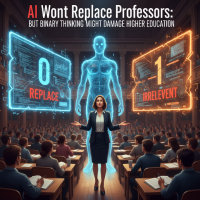
Can AI replace professors? Across higher education this question is often treated as a yes-or-no proposition. Either AI is about to make professors obsolete or it is dismissed as a trivial tool unworthy of serious academic work. This “zero or one” mentality risks distorting policy, undermining academic integrity and weakening capacity for innovation.
A better starting point is to be clear about what AI is and what it is not. Generative AI systems like ChatGPT are built on deep learning and large language models. They are sophisticated statistical engines trained on massive amounts of text to predict the most likely next word or phrase. They do not understand language in a human sense; they recognize and reproduce patterns in how language has been used in the past. They can imitate structure, style and tone, but they lack intention, consciousness and responsibility.
This distinction matters. Academic research is not an exercise in recombining sentences from the past. Professors are not just transmitters of information. They identify meaningful questions, build hypotheses, design methods, challenge assumptions and construct new theories. These activities demand creativity, nuanced judgment and deep critical thinking which are qualities that remain beyond the capabilities of AI.
Recognizing both the promise and the limits of AI, UNESCO adopted its Recommendation on the Ethics of Artificial Intelligence in 2021. The document calls for a human-centered approach. In education and research it emphasizes that academic freedom and creativity must be preserved and that AI should augment not displace human agency and judgment.
Yet the way universities are reacting to AI often departs sharply from this balanced, human-centered vision. Institutional practice has become fragmented and polarized. Within the same university, different departments and courses may adopt incompatible policies, leaving students to navigate a confusing maze of expectations.
A recent case at Nanyang Technological University in Singapore illustrates the risks of the restrictive approach. Local media reported that a student was given a zero on a written assignment because the professor suspected he had used AI. The student responded by providing a recording of his writing process showing use of citation managers and spell-check tools but not generative AI. Despite this the professor maintained that the student had violated academic integrity and the penalty stood. The controversy was not only about whether one student cheated. It highlighted two deeper problems: conceptual confusion about what counts as AI and a growing disconnect between university practices and broader societal needs.
Today many everyday tools embed AI: grammar suggestions, predictive text, translation aids and spam filters among others. If faculty rely on such tools but prohibit students from using them, policy becomes inconsistent and hard to defend. At the same time many countries are explicitly committed to building AI-ready innovation-driven economies. If universities respond by banning or stigmatizing AI in the classroom they risk sending graduates into AI-intensive workplaces without the literacy and judgment those workplaces demand.
At the opposite extreme, a permissive “anything goes” attitude carries its own dangers. The journal China Population and Development Studies published an article by a professor at another leading Asian institution, the University of Hong Kong, which was later found to contain a large number of fabricated citations. Apart from AI “hallucinations” commentators also noted that the article offered little genuine innovation, appearing mainly to reassemble existing ideas without meaningful theoretical or empirical contribution.
This is what uncritical dependence on AI can produce: papers that look like scholarship but lack substance with plausible prose masking shallow analysis and unreliable sources. Generative AI is very good at imitating the outward form of academic writing, but form alone does not make research. Quality scholarship depends on asking important questions, choosing sound methods, gathering and evaluating evidence and advancing knowledge in ways that can be scrutinized and tested by others. No current AI system can independently ensure any of these requirements are met.
Taken together the Singapore and Hong Kong cases represent opposite ends of the same spectrum. On one side is a “zero policy” in which AI is treated largely as a threat to academic integrity to be banned or severely restricted. On the other side is a “one policy” in which AI is allowed to permeate academic practice with minimal oversight. Both approaches fall into the trap of binary thinking and both stray from UNESCO’s call for human-centered AI that strengthens rather than weakens the core values of education and research.
A more constructive path requires moving beyond this binary. It means recognizing legitimate uses such as managing citations or checking grammar while drawing firm lines against practices that outsource core intellectual work such as generating entire essays or fabricating data and references. It further means ensuring that students encounter broadly consistent expectations rather than a patchwork of rules that change from classroom to classroom. The real risk is not that AI will suddenly make professors redundant. Professors remain irreplaceable in the AI era. It is that “zero or one” thinking will erode the human purposes of higher education.
Author: Wilson Wong is the Founding Director and an Associate Professor of Data Science and Policy Studies (DSPS), School of Governance and Policy Science at The Chinese University of Hong Kong (CUHK). He is also a Senior Research Fellow at the School of Management, UCL and a Fellow at the Center for Advanced Study in the Behavioral Sciences (CASBS) at Stanford University. His major research areas include AI and Big Data, digital governance, ICT and comparative public administration.
 (No Ratings Yet)
 Loading...
Follow Us!