Widgetized Section
Go to Admin » Appearance » Widgets » and move Gabfire Widget: Social into that MastheadOverlay zone

The Code Coup: Blockchain Bureaucracy and the Quiet War on Discretion
The views expressed are those of the author and do not necessarily reflect the views of ASPA as an organization.
By David P. Adams
February 6, 2025
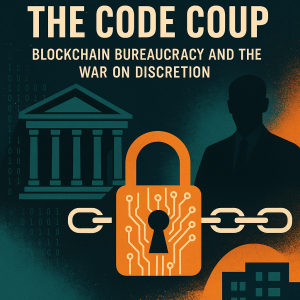
While the country debates Trump’s latest headline, a quieter revolution is unfolding, one that could remake public administration from the inside out.
The second Trump administration has declared war on what it calls “the tyranny of the bureaucracy.” But this isn’t just a campaign to fire career civil servants. It’s a plan to replace them with code.
The Department of Government Efficiency (DOGE) spent its brief life pushing to embed blockchain across federal operations. DOGE as a unit has now been wound down but its agenda has migrated. Treasury is embracing blockchain-based infrastructure for exchanges and tokenized government securities. Other agencies are piloting distributed ledgers for identity systems, logistics and procurement. The goal in each case is the same: eliminate discretion, automate enforcement and treat policy not as something to interpret but something to execute. In this vision, rules aren’t debated or adapted. They’re compiled, deployed and immutable.
This isn’t e-government. It’s administrative redesign.
Blockchain governance systems, once championed by tech optimists for their decentralizing potential, are now being used to bypass judgment entirely. Smart contracts can already reallocate benefits, trigger penalties or deny access—no human decision required. The appeal to the New Right is obvious: no meddling experts, no liberal administrators, no resistance. You don’t need a deep state if you have an obedient smart contract. We are watching an early form of what many now call algorithmic governance: rules and routines embedded in code, with less and less room for human interpretation.
This techno-political shift fuses old grievances with new tools. As Nathan Levine noted last summer in The New York Times, political theorist James Burnham warned in the 1940s of a rising “managerial class” controlling democratic institutions from behind the scenes. Today’s anti-administrative right has revived that argument—but with a twist. It doesn’t just want to rein in bureaucrats. It wants to recode them out of existence.
To the blockchain faithful, this is purity. Rules are rules. They don’t bend, pause or reflect. But governance without discretion is not fairness. It’s authoritarianism by algorithm.
Imagine a welfare system that cuts off food assistance because a checkbox wasn’t ticked. Or a carbon market that penalizes small farmers using sensor data with no regard for drought or environmental justice. These aren’t hypotheticals. In California, groundwater rights are being turned into digital tokens. In Japan, carbon offsets are being automated. Humanitarian aid is already being distributed by blockchain wallet and biometric scan—no caseworker involved.
Yes, efficiency might improve. But ethics disappear.
For public administrators, the stakes are clear. Blockchain doesn’t just digitize government. It redefines it. It elevates Herman Finer’s vision of strict rule-following to a degree even Finer might have rejected, stripping out the professional norms and judgment Carl Friedrich saw as essential to democratic accountability. Governance becomes execution. Interpretation becomes error.
This shift collapses David Rosenbloom’s three pillars of administration—law, politics and management—into one: managerial control. It’s the old “cult of efficiency” that Paul Appleby warned about, dressed up in validator nodes and cryptographic ledgers.
And it’s not neutral. These systems encode the values of their designers. Public problems become data flows; discretion becomes a bug to eliminate. The result is a system that feels objective but quietly entrenches the power of those who write the code.
But resistance is growing. Civic technologists and public interest developers are using blockchain’s architecture to build decentralized tools that protect equity, transparency and accountability. They mirror erased federal data, embed access rules into smart contracts and create community-controlled platforms for public decision-making. In public administration terms, this is a kind of guerrilla governance infrastructure: informal, often improvised, but aimed at keeping space open for judgment, dissent and care inside increasingly coded systems. These systems don’t reject bureaucracy. They reimagine it with democratic intent.
Still, they remain on the margins. Without broader institutional support, they risk being outpaced by efforts to automate away the public in public service.
The choice ahead isn’t just about technology. It’s about values. Who governs? Who decides? And whose code runs the state?
Because once these systems are entrenched, the space for interpretation, adjustment and democratic input narrows. Policy doesn’t disappear. But it becomes harder to shape, challenge or humanize.
Author: David P. Adams is Associate Professor and MPA Director at Cal State Fullerton. His work focuses on collaborative governance, institutional resilience and the intersection of technology and governance. More about his work is available at dadams.io, and he can be reached at [email protected]. A longer treatment of these themes appears in his article, “The Code Is the Policy,” in Administrative Theory & Praxis.

 (1 votes, average: 4.00 out of 5)
 Loading...
Follow Us!