Widgetized Section
Go to Admin » Appearance » Widgets » and move Gabfire Widget: Social into that MastheadOverlay zone
Playing Chess in a Burning Room: Why Robust Organizations Matter for Policy Making in an Age of Turbulence
The views expressed are those of the author and do not necessarily reflect the views of ASPA as an organization.
By Lorenzo Eaco
February 13, 2026
Contemporary policymaking has been compared to playing a game of chess against an invisible opponent who is constantly two moves ahead while the room is on fire and everyone shouts opposing game-winning strategies. This metaphor, although exaggerated, reflects how today’s public administrations often operate.
What lies at the root of this chaotic and uncertain environment? One explanation points to demographic shifts, urbanization, technological advancement and economic constraints, all of which create concrete challenges for policymaking. Another explanation centers on the evolving nature of public problems, many of which are complex, non-linear, multidimensional and conflictual.
Additionally, governance structures are increasingly pluricentric and polycentric, reshaping public affairs and introducing a new normal in public governance.
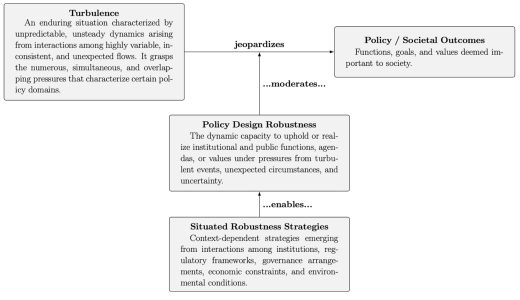
Regardless of the cause, one question remains: how do governments operate when stability is replaced by chronic turbulence? One answer lies in a concept that deserves greater attention: robustness.
Beyond Resilience: The Analytical Value of Robustness
Although resilience has received significant attention as the ability to recover from disruption, robustness extends beyond recovery or returning to stability. Robustness focuses on maintaining consistent performance despite ongoing disruption. Organizations must remain effective while adapting to uncertain and unpredictable contexts.
Robustness therefore represents the ability to preserve essential functions while operating in environments defined by instability. Just as a commercial aircraft is designed to remain stable during turbulence and air pockets while ensuring passenger safety, public organizations must maintain service delivery regardless of instability in their operating environments.
Lessons from Water Governance
Water utilities provide a clear example of why robust organizations are increasingly necessary.
The World Resources Institute has indicated that the United States is likely to face higher water risk sooner than previously expected, with states such as California and New Mexico experiencing severe stress levels as global temperatures rise. In the European Union, the European Environment Agency reported that in 2022 nearly one third of EU territory experienced seasonal water stress, with projections indicating continued growth in future years.
These challenges extend beyond water supply. They influence agriculture, energy production, public health and economic performance. Water governance operates within interconnected socio-ecological systems where infrastructure and environmental change influence one another.
Climate change is only one factor affecting water governance. The water sector also faces aging infrastructure, unclear regulatory frameworks and limited financial resources. These pressures not only test water service systems but also reshape how those systems operate. Under these conditions, robustness becomes essential.
A robust water utility must operate effectively under uncertainty and pressure. Organizations must be capable of adjusting supply operations to meet demand regardless of climatic challenges such as droughts, storms or fires, infrastructural failures such as treatment or pumping disruptions and economic limitations such as funding shortfalls.
Four Major Domains Shaping Organizational Robustness in the Water Sector
Building on existing scholarly discussion, four domains shape robustness in water utilities:
- Environmental Conditions
Environmental factors influence access to water resources and determine the quality of available water sources. These material conditions directly affect the core functions of water utilities. - Regulatory Regimes
Regulations establish norms, objectives and operational standards. They shape the conditions that allow organizations to design systems capable of managing complexity and uncertainty. - Governance Architectures
Water utilities often operate within complex networks involving multiple public and private actors responsible for decision-making, resource allocation and service delivery. Clearly defined roles and effective coordination across actors are essential for system stability. - Economic and Financial Capacities
Financial strength affects both internal operations and external service delivery environments. Research consistently highlights the importance of financial capability in supporting infrastructure reliability, operational continuity and system durability.
These domains are interdependent and should be considered collectively. Together, they provide a useful framework for both empirical analysis and practical application in public administration.
The Bottom Line: Navigating Turbulence with Robustness
The future of public administration in a volatile, uncertain, complex and ambiguous environment depends on the ability of decision-makers to design governance models and organizational structures that extend beyond reactive responses. Public institutions must be capable of maintaining effective performance under continuous pressure and uncertainty. Strong governance systems allow organizations to continue delivering public value even when operating conditions are unstable.
Author: Lorenzo Eaco is a PhD candidate in Political Science at University of Bologna. His research focuses on water utilities, with particular emphasis on how environmental, governance, regulatory and financial dimensions interact to shape organizational robustness.
 (4 votes, average: 5.00 out of 5)
 Loading...
Follow Us!