Widgetized Section
Go to Admin » Appearance » Widgets » and move Gabfire Widget: Social into that MastheadOverlay zone
Public Administration and Governing Principles in the Declaration of Independence
The views expressed are those of the author and do not necessarily reflect the views of ASPA as an organization.
By Stephen M. King
May 8, 2026
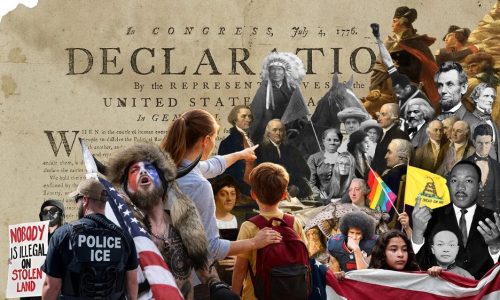
On July 4, the United States will celebrate the 250th anniversary of the Declaration of Independence (the D of I). Although it is not a governing document, it contains ideas framing the contours of our political and administrative systems. In a recent essay, Charles Wise of the John Glenn School of Public Affairs examined four of these principles, asking two questions: “Where has our country succeeded in meeting the Declaration of Independence goals and values?” and “Where do we need to make improvements?” This essay addresses a third question: “How are these principles related to the practice of public administration?”
First, “all men are created equal” is the fundamental democratic principle that states all citizens are equal before the law. The phrase means all humans are born with inherent natural rights; government cannot silence them. It is a moral foundation of the constitutional republic and should guide public administration. Inequality was rampant in the late 18th century, not only in the colonies but across much of the known world. Professor Wise noted the clause “established a premise for the formation of the Constitution, which put in place a set of institutions that engaged democratic processes to fulfill over time equality.” Yet inequality exists.
How should public administration address inequality? Because inequality will not be eliminated and holistic change is unrealistic, it is essential that public administration at all levels of government and in every service and program area devote time and resources to ensure all individuals, regardless of race, ethnicity, gender or other demographic, are incrementally afforded equality under the law. Promotion of social equity and continuation of representative bureaucracy are forces for addressing inequalities and injustices. Proper development, implementation and measurement of DEI initiatives and FAIR policies are also important. Public administration must work with, not against, policymakers, regardless of party or ideology, following administrative procedures and processes that promote the greater good.
Second, individuals are “endowed by their Creator with certain unalienable Rights…” This phrase is based on both religious beliefs and Enlightenment philosophical principles. The bridge between the two is the providential work of God in the affairs of humankind. Unlike God, however, government power is limited and public administration must operate within the confines of the law, working to protect God-given rights such as life, liberty and the pursuit of happiness. On a daily basis public servants such as police and law enforcement work to ensure Fourth Amendment rights are protected. Local public school officials are accountable for protecting students’ First Amendment rights to free speech and exercise of religion. When the inevitable clash between opposing forces occurs, it is the responsibility of public officials to follow administrative procedures and adjudicate issues fairly and honestly.
Third, “…Governments are constituted among men, deriving their just powers from the consent of the governed…” More importantly, the people decide which aspects of power they will delegate to government. Today administrative agencies at all levels of government abide by administrative procedure law, restricting agency actions and providing greater transparency to rulemaking and adjudication. While governments require opportunities for citizens to voice concerns in public venues, file Freedom of Information Act (FOIA) requests or submit complaints through various platforms, public administration professionals sometimes argue that technical expertise outweighs the right of the people to disagree, particularly during crisis events such as COVID-19. Expertise must be balanced with citizens’ right to accurate information.
Fourth, “…when any Form of Government becomes destructive of these ends, it is the Right of the People to alter or to abolish it, and to institute a new Government…” Over time, the people have changed government through various constitutional amendments. In addition, states offer direct democratic mechanisms including initiatives, referendums and recalls to bypass legislative bodies. Would the National Popular Vote Interstate Compact (NPVIC) create similar challenges? The Compact would guarantee the presidency to the candidate who wins the national popular vote, countering the original purpose of the Electoral College of balancing interests of large and small states. Opponents contend the Compact is unconstitutional and that Article I, Section 10 does not allow states to enter into agreements with each other without congressional approval. If enacted, opponents further claim national elections will be in disarray, legal challenges will mount, recounts will continue and federalism will be weakened. How should public administration respond?
State and local election officials have the administrative responsibility to ensure electoral integrity. This requires they act in a nonpartisan manner and resist public pressure to do otherwise. Will they always act perfectly? Of course not, but for the public to trust elections are free and fair, officials must act with honesty and transparency. Principles are empty if not accompanied by sincerity of action. The legitimacy of the republic depends on it.
Author: Stephen M. King is Professor of Government at Regent University, Virginia Beach, VA. He teaches undergraduate courses in American politics, state and local government and public policy and has taught graduate courses in public policy analysis and ethical leadership and administration. He publishes on ethics, public administration and leadership. He served as President of the Hampton Roads Chapter of ASPA (AY24-25), sat on the Advisory Council for SEIGov, ASPA (AY21-24) and is on the editorial board of the Virginia Journal of Public Administration (2025-). His latest book is Ethical Public Leadership: Foundation, Organization, and Discovery (New York: Routledge, 2023). Contact him at [email protected]
 (No Ratings Yet)
 Loading...
Follow Us!