Widgetized Section
Go to Admin » Appearance » Widgets » and move Gabfire Widget: Social into that MastheadOverlay zone
Leading With Purpose and Practice: Your Call To Convene, Listen and Build
The views expressed are those of the author and do not necessarily reflect the views of ASPA as an organization.
By Tony Spearman-Leach and RaJade M. Berry-James
May 29, 2026
Public service is not merely a profession you enter. It is a covenant you inherit, practice and renew.
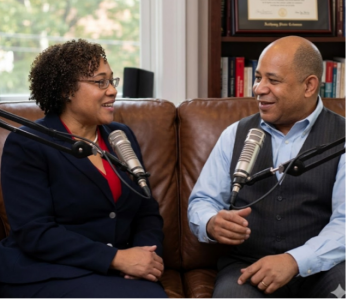
That conviction framed “Convening Conversations: Leading with Purpose and Practice,” a Public Service Recognition Week dialogue with Tony Spearman-Leach of the National Academy of Public Administration. RaJade M. Berry-James of the VCU Wilder School and José Luis Irizarry of the Department of Public Administration at North Carolina Central University convened the event on behalf of the ASPA Research Triangle Chapter and ASPA’s Student and New Administrative Professionals Section, where Irizarry serves as president-elect. Designed as a “living room-style” conversation, the gathering invited participants to bridge theory and action and reflect on leadership that convenes people around shared purpose.
When you serve the public, you do more than manage programs or implement policy. You hold responsibility for people who may never know your name, but whose lives are shaped by your judgment, integrity and commitment to making government work well and work well for all.
Recognition Must Become Responsibility
Public Service Recognition Week gives us a moment to honor the clerks, analysts, first responders, educators, administrators, agency leaders and frontline workers who keep public institutions functioning. Yet recognition cannot end with applause. It must become renewed responsibility.
At the National Academy of Public Administration, that responsibility is reflected in the Celebration of the American Public Servant, or CAPS, a year-long effort to elevate public servants through stories, convenings, podcasts, blogs, webinars, a traveling exhibition and a June 22 gala at the Library of Congress.
We are living and leading in a time when public administration requires courage and precision. Institutions are changing. Communities are asking hard questions. In that shared reality, public servants cannot abandon principle. You may, however, need to choose words that keep people in constructive conversation.
Language That Keeps Us in Conversation
One central lesson was that public servants must find language that allows people with different perspectives to remain at the table. The Academy’s “Words that Work” effort was discussed as one example of how shared vocabulary can sustain civil conversations across political differences.
The aim is not to compromise fairness, dignity or justice. The aim is to keep doing the work: seeing people, hearing people, acknowledging people and serving all people well.
This is where comprehensive community building becomes practice. You build community when you invite people into the room. You sustain it when you listen across disagreement. People experience institutions through laws and procedures, but also through tone, eye contact, welcome and respect.
For public servants and those preparing to serve, everyday conduct matters. The way someone is greeted matters. The way a concern is heard matters. Public administration is implemented through budgets, regulations and strategic plans, but also through daily habits of dignity.
Purpose Becomes Practice
Public servants also lead during a period of institutional upheaval. Departments may be restructured. Budgets may be constrained. Roles may change. But the calling remains constant: preserve essential services, strengthen public institutions and ensure that people are not lost in the machinery of change. The task is not only to defend institutions, but to help people see how systems can be healed, redesigned and made worthy of public trust.
The conversation offered practical examples. The Academy’s District of Columbia TANF study brought executive leaders, frontline workers and program beneficiaries together to examine how public systems can better serve families moving toward self-sufficiency. The emerging Hrabowski and Shalala Scholars internship awards effort responded to another challenge: talented students from socioeconomically challenged backgrounds often cannot afford unpaid or under-supported opportunities in Washington, D.C.
None of us can do this work alone. Public-private and nonprofit partnerships are essential to modern governance. Durable solutions require partners to listen, identify shared interests and make a persuasive case for social return on investment and shared public value. Strong partnerships are built by inviting others to help solve shared problems.
We must also tell the story of public service. Stories humanize government. They remind communities that institutions are made up of people who choose service, often quietly and under pressure. Storytelling builds identity, sustains morale and helps the public understand service beyond headlines and abstractions.
The May 5 virtual convening modeled what this work requires. It brought together ASPA chapters and sections, universities, professional associations and public administration partners, including the National Academy of Public Administration, National Forum for Black Public Administrators, NASPAA, the VCU Wilder School, the Department of Public Administration at North Carolina Central University and other academic and professional partners.
That coalition is a reminder: no single institution owns the future of public service. We build that future through networks, relationships, shared values and a willingness to convene across sectors, disciplines, communities and generations. Then each of us carries that shared work forward in the places where we lead, serve, teach, learn and convene.
So your charge is clear: Do not merely admire public service. Practice it. Do not cling only to labels. Do the work. Convene generously. Lead courageously. Listen deeply. Build comprehensively.
Public service is how you choose to stand in relationship with your community, your institutions and generations still to come. Carry that responsibility forward by mentoring an emerging public servant, sharing a story of service, joining the next convening or recommitting to the daily habits that make government worthy of public trust.
Authors: Tony Spearman-Leach is the senior director of institutional advancement at the National Academy of Public Administration and an Excelsior University trustee. He can be reached at [email protected].
RaJade M. Berry-James is senior associate dean of faculty and academic affairs at the L. Douglas Wilder School of Government and Public Affairs at Virginia Commonwealth University, NASPAA past president and a Fellow of the National Academy of Public Administration. She can be reached at [email protected].
 (1 votes, average: 5.00 out of 5)
 Loading...
Follow Us!