Widgetized Section
Go to Admin » Appearance » Widgets » and move Gabfire Widget: Social into that MastheadOverlay zone
The High Cost of “Making It Work”: Why Transparency Is a Management Mandate
The views expressed are those of the author and do not necessarily reflect the views of ASPA as an organization.
By George S. Welch
June 19, 2026
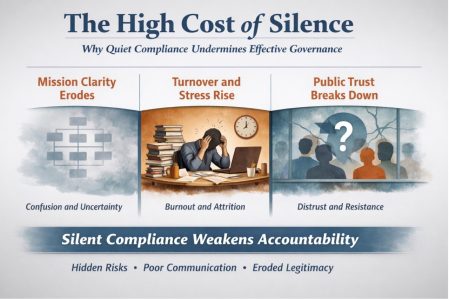
Quiet compliance may keep work moving in the short term, but when transparency gives way to silence, agencies pay the price through eroded mission clarity, rising burnout and declining public trust.
In public administration, “making it work” is often treated as the highest professional virtue. When institutions stall, public servants are expected to bridge the gap between policy intent and operational reality. That strain often appears as fast executive action, delayed legislative response or late and unclear court decisions. Stoicism in these moments is often praised as a mark of neutral competence. But there is a hidden and rising cost to that silence. When public managers quietly absorb institutional strain, they risk normalizing unrealistic directives and weakening the guardrails that keep government legitimate.
The Heroism Trap
The heroism trap appears when public servants implement high-conflict decisions while absorbing reputational blowback for choices they did not make. In an effort to be helpful, or simply to avoid appearing obstructive, managers may rush implementation or adapt to vague guidance without clearly flagging the risks.
That pattern does not operate in a vacuum. It creates a climate of suspicion. When the public perceives that government is acting without meaningful checks, frontline staff often pay the price through more conflict in routine interactions involving enforcement, benefits administration and public health. “Making it work” without transparency may solve a short-term political problem, but it creates long-term management failures.
Mission clarity erodes: Staff lose sight of core objectives when implementation moves faster than explanation.
Turnover risk rises: Professionals asked to carry inconsistent or aggressive guidance without support are more likely to leave public service.
Compliance weakens: When the public cannot understand what is expected, cooperation breaks down.
Transparency as a Management Mandate
To counter these risks, transparency must be treated as a management mandate rather than a secondary democratic ideal. Legitimacy is what allows agencies to function. Protecting that legitimacy requires administrative action that is lawful, consistent and explainable.
Public managers should move beyond minimal compliance and lead with integrity through three practical disciplines.
- Operationalizing Traceability
Discretion is unavoidable in public service, but it must be defensible. Managers should require short decision memos for high-impact calls so the “why” is preserved alongside the “what.” Documentation is not red tape. It is an accountability guardrail that protects both the agency and the individual professional.
- Standardizing Public Guidance
When policy direction changes faster than internal controls can adapt, the risk of error and inconsistency rises sharply. Agencies should prioritize clear, plain-language updates that tell the public what has changed, what is expected and how rules will be applied. Consistency also depends on training. Teams should not be left to rely on the improvisation or “heroism” of individual staff members to guess the right path.
- Candid Communication Up the Chain
The most difficult, and often most necessary, part of this mandate is candid communication up the chain of command. Public managers have a professional obligation to report implementation limits, staffing realities and legal risks. Silence in the face of unrealistic directives does not protect the agency. It normalizes weak accountability and increases the chance of failure. Managers can frame these concerns as technical capacity assessments by documenting staffing limits, training gaps, legal risk and implementation timelines rather than presenting them as political objections.
The Difference Between Function and Cynicism
Public administration is the work of making democracy real. When institutions appear stalled, the temptation to retreat into quietly “making it work” is strong. But the better path, and the one that protects the long-term health of the state, is to lead with process.
By insisting on clarity before execution, documenting decisions for accountability and identifying disparities early, public servants protect legitimacy where they stand. These everyday disciplines help preserve credibility, consistency and trust. When guardrails feel weak, the mandate of the public servant is not to hide the cracks, but to reinforce the standards that keep government legitimate.
Author: George S. Welch is a public administration scholar and public servant focused on governance, accountability and institutional capacity. Contact: [email protected]
 (No Ratings Yet)
 Loading...
Follow Us!