Widgetized Section
Go to Admin » Appearance » Widgets » and move Gabfire Widget: Social into that MastheadOverlay zone
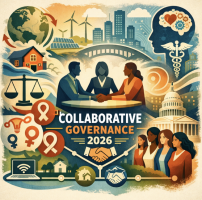
Beyond the Divide: Why 2026 Must Be the Year of Collaborative Governance
The views expressed are those of the author and do not necessarily reflect the views of ASPA as an organization.
By Denise Hendrix
December 22, 2025
As 2025 draws to a close one truth stands out: polarization has shifted from a political condition to a policy crisis. This year partisan gridlock stymied progress, delayed funding, and deepened public distrust. Nonprofits often the first responders to community need found themselves operating with shrinking resources, rising demand and little certainty.
And yet beneath the noise of division a different story unfolded. Across the country a growing number of public agencies and nonprofit partners chose to collaborate not just as a tactic but as a governance strategy. Their success offers a compelling path forward: collaborative governance is not a buzzword; it is a blueprint.
In Congress budget showdowns delayed appropriations and forced agencies into short-term spending patches. Essential programs from food assistance to housing saw funding disrupted. Nonprofits were left scrambling to backfill services while navigating a patchwork of state-level policy reactions.
States fared no better. Political division turned once bipartisan efforts such as early childhood education public health and infrastructure into ideological battlegrounds. As a result critical issues went unresolved and policy implementation grew increasingly fragmented.
Nonprofits play a vital role in delivering public services but in 2025 they operated under heightened strain. Federal delays and shifting state priorities made it difficult to plan or staff effectively. Yet nonprofits continued to innovate often stepping into policy gaps with limited support.
Nonprofits are not just service providers they are policy actors. We need to bring them to the table not just call them in after decisions are made. When public institutions invited nonprofits into shared leadership roles the results were striking.
In Minneapolis the Stable Homes Stable Schools initiative aligned city county and school district resources with nonprofit housing partners to support families experiencing homelessness. By coordinating rental assistance and support services the program helped stabilize over 1,000 households and improved school attendance for thousands of students. Shared data and joint planning were key to its success.
Phoenix launched the Heat Ready Initiative partnering with health systems and nonprofits to respond to record-breaking heat waves. Through joint planning and pooled resources the program reached more than 12,000 vulnerable residents offering cooling centers hydration stations and medical aid.
In Charlotte NC the city partnered with the Charlotte-Mecklenburg Housing Partnership and veteran-focused nonprofits to launch Housing Our Heroes. The program combined federal housing vouchers with wraparound supports like employment mental health care and legal aid. With shared metrics and monthly cross-sector planning meetings the initiative housed over 800 veterans in one year.
Nowhere was the need for collaboration more urgent in 2025 than immigration. With federal reform stalled cities and nonprofits stepped in. In Chicago an immigrant resource hub connected newcomers with healthcare legal aid and housing through cross-sector coordination. In El Paso schools churches and city departments launched a community education hub for migrant youth.
These efforts proved that even when federal leadership falters local collaboration can provide responsive humane solutions and rebuild trust in governance.
To move from one-off success stories to sustainable models collaboration must be built into governance systems. That means:
-
Formalizing cross-sector partnerships with clear roles and shared decision-making
-
Funding nonprofit capacity not just service contracts
-
Aligning accountability metrics with collective outcomes
-
Centering community voice in both design and delivery
People are tired of political theater instead they want results and results come when we work together.
The message of 2025 is clear: We cannot solve 21st-century challenges with 20th-century structures. Fragmentation fails communities. Collaboration delivers.
As we enter 2026 we have a choice. Continue down a path of division or commit to governance that is inclusive accountable and impact-driven. Public administrators and nonprofit leaders have the tools the networks and the mandate to lead that shift. The urgency for collaborative governance is clear.
In 2026 we must shift from intention to infrastructure building the systems relationships and leadership models that make collaboration the norm not the exception. Public and nonprofit sectors will need to co-create solutions for climate displacement digital equity AI in public service and mental health access. Gender equity must also move to the forefront from reproductive rights and menopause awareness to workplace protections and women’s leadership in policy. These challenges demand more than coordination; they require co-governance grounded in trust equity and accountability.
Let us stop waiting for consensus and start building coalitions. The future depends on it.
Author: Dr. Denise Hendrix is a public administration professional and adjunct professor with expertise in collaborative governance homelessness policy and nonprofit public sector partnerships. With a background in both scholarship and practice Hendrix focuses on improving system coordination and empowering public and nonprofit leaders. Contact: [email protected]
 (3 votes, average: 5.00 out of 5)
 Loading...
Follow Us!