Widgetized Section
Go to Admin » Appearance » Widgets » and move Gabfire Widget: Social into that MastheadOverlay zone

Don’t Let AI Break the Social Contract
The views expressed are those of the author and do not necessarily reflect the views of ASPA as an organization.
By Tanya Settles
August 15, 2025
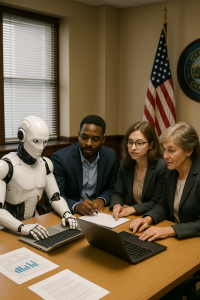
The promise of artificial intelligence (AI) is alluring. Agentic, also known as autonomous, AI systems are those capable of taking actions independently toward defined and bounded goals. The benefits include the capability of optimizing service delivery, earlier identification of inefficiencies and potential response in real time to certain types of problems or processes. For overburdened local governments, these tools offer potential relief to resource challenges and restraints, but right below the surface is a deeper concern. If—or when—AI systems act in place of humans, do we risk undermining the social contract that is the moral foundation of democracy?
The Social Contract Risk
The social contract is far more than a mere philosophical idea. It guides democracy as the moral glue that binds government and governed through a tacit agreement with mutual responsibilities and obligations. Local governments are the most accessible expressions of the social contract because of proximity between people and government. They are also more susceptible to risks associated with building and sustaining trust in how decisions are made and the people who make them.
Agentic AI is an artificial intelligence system that can complete tasks with limited human supervision. It consists of a design using AI agents that mimic human decision making to solve problems through algorithms based on large datasets and may be configured to make decisions without direct human intervention. For some community members, this can be problematic especially when an adverse decision is made by a machine that feels arbitrary or in violation of consent. Consequently, there are some ethical pitfalls and democratic dilemmas that occur, including questions about:
Opacity: Many AI systems operate as “black boxes.” Their inner workings are inscrutable, constantly evolving and changing and government staff and community members may not be able to trace how, exactly, a particular decision is made. This undermines transparency.
Bias: AI is only as fair as the data it is trained on. Historical data may reflect entrenched inequalities. When these biases are encoded into decision-making systems, inequity becomes automated and more difficult to detect.
Accountability: Local governments must take the ethical lead and consider who is responsible when an AI system gets it wrong. Does responsibility lie with the developer? An employee? Elected officials? Agentic AI is advancing quickly, there aren’t a lot of leading practices, and there aren’t always clear lines of responsibility. When this happens, public accountability erodes.
Legitimacy of Democracy: Governments derive legitimacy from public consent, equality and respect for the rule of law and ownership of decision making. When decisions are outsourced to machines without civic input or consent, the social contract that legitimizes public power may be weakened.
It Doesn’t Have to Be This Way
AI can be a force for good. It can reveal patterns of inequity, streamline services, reduce barriers to government access and free time and resources for staff to focus on complex human-centered challenges. When designed with a focus on fairness and community values, autonomous tools can strengthen government legitimacy.
To address the ethical pitfalls, what matters is how local governments approach the integration of agentic AI:
- Humans-in-the-loop design should be standard for any AI system making consequential decisions. This means that instead of thinking of agentic AI as the removal of human involvement, we purposefully build systems that include human participation and oversight.
- Clear accountability frameworks must ensure that human officials remain answerable for the actions of their digital agents. One way of thinking of this relationship is that digital agents are teammates to human employees. This creates a path for accountability that mimics full human decision making.
- Public input should be built into important processes including AI design and training, implementation, evaluation and community control of uses of their data, particularly data that may be personally identifiable. Or, as Carl Sagan said shortly before his death, “I mean, who is running the science and technology in a democracy if the people don’t know anything about it?”
- Ethical review boards can serve as watchdogs to ensure AI tools align with community values, human decision making and proper scientific application.
Agentic AI is not inherently unethical, nor does it necessarily violate the social contract, but it is inherently powerful. Power in a functional democracy must be exercised with consent and care. If local governments automate decisions without building transparency, equity and accountability in the process they risk fraying the contract that gives them the right to govern. The challenge is not resolved by rejecting machine automation, but acceptance adds to the complexity of governing AI before it governs us.
Author: Tanya Settles is the CEO of Paradigm Public Affairs, LLC. Tanya’s areas of work include relationship building between local governments and communities, restorative justice, and policy and program strategy and evaluation. Tanya can be reached at [email protected]. The opinions in this column and any mistakes are hers alone.
 (1 votes, average: 5.00 out of 5)
 Loading...
Follow Us!