Widgetized Section
Go to Admin » Appearance » Widgets » and move Gabfire Widget: Social into that MastheadOverlay zone
Heterarchy, Global Turbulence and the End of Territorial Politics
The views expressed are those of the author and do not necessarily reflect the views of ASPA as an organization.
By Dana-Marie Ramjit
August 1, 2025
Introduction
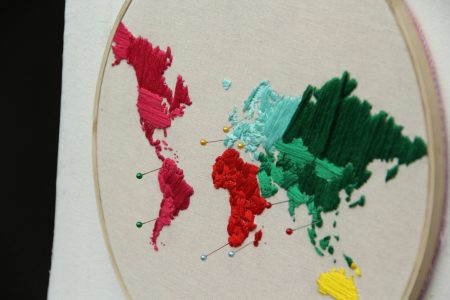
We are living in a time of deep political, social and economic turbulence. Global crises have accelerated structural transformations, intensified uncertainty and given rise to new forms of socio-political organization. The traditional boundaries between domestic and international, state and non-state, are increasingly porous. As states struggle to assert sovereignty, corporate and technological actors grow in influence and the nonprofit sector redefines legitimacy and authority. The COVID-19 pandemic amplified these shifts, legitimizing virtual governance and accelerating the erosion of territorial political models. In today’s world, power is no longer anchored in geography but dispersed across overlapping centers of authority. This postinternational condition gives rise to heteronomous governance, organized around functions rather than borders. Heterarchy, marked by diverse and networked structures, challenges state centrality and enables multi-nodal coordination (Rosenau, 1990; 2003). In this landscape, knowledge, agency and innovation are distributed rather than monopolized. Heterarchy offers a compelling lens through which to understand the emerging global order, one that is adaptive, decentralized and responsive to the turbulence of our time.
Postinternational Politics
Post-WWII society underwent profound transformations: specialized labor expanded, new actors emerged, authority fragmented and global connectivity surged. Advances like expanded voting rights and mass media fueled democratization, dissolving traditional boundaries and creating cognitive disequilibrium, a tension between local understandings and global realities.
Postinternationalism captures this dynamic, interconnected world where state-centric models increasingly fail to address complex global challenges. At its core is turbulence, the unpredictable interplay of forces spanning individuals, institutions and technology, manifesting in crises such as climate change, terrorism, pandemics and state failure. This turbulence has reshaped governance: sovereignty now disperses across a multilevel, pluricentric system where states coexist with transnational networks and empowered citizens. Once passive, individuals are now active participants in governance through digital and civil platforms. Growing dissatisfaction with traditional state responses accelerates the shift toward decentralized, networked authority. In this context, postinternational theory offers vital insight into an evolving global order.
Heterarchy and the New Political Order
Contemporary politics is increasingly multi-centric and layered, spanning global, regional, national, local and individual levels. This complexity stems from technological disruption, environmental crises and shifting socio-economic paradigms. The traditional Westphalian model of sovereign, hierarchical governance has given way to dispersed authority shared among states, corporations, NGOs and transnational networks. This evolving landscape exemplifies heterarchy, a flexible, non-hierarchical system characterized by overlapping, decentralized structures. Originally conceptualized in neuroscience (McCulloch, 1945) and later applied to social and political systems (Stark, 2001; Kontopoulos, 1993), heterarchy enables governance across blurred boundaries through dynamic interaction, mutual monitoring and adaptive coordination. Unlike rigid hierarchies, heterarchies thrive on distributed intelligence and lateral authority. In turbulent, uncertain environments, no single actor holds all power or knowledge. Instead, governance becomes collaborative, innovation arises from diversity and solutions are co-created across sectors. Heterarchy complements the postinternational condition by embracing complexity, supporting flexible authority and addressing super-wicked problems, issues like climate change, pandemics and inequality that defy traditional policy solutions. It also acknowledges the coexistence of hierarchical and heterarchical elements, much like the interplay of globalization and localization. For public administrators, this means actively engaging cross-sector networks, decentralizing decision-making and adopting adaptive governance tools. Political effectiveness now depends less on centralized control and more on networks, communication and continuous learning. Heterarchy offers a practical framework for managing today’s fragmented, networked political realities.
Conclusion
In today’s turbulent and volatile global environment, change is the only constant, often unsettling yet full of opportunity. The COVID-19 pandemic sharply exposed the limits of traditional governance, reshaping political attitudes and revealing deep divides in public trust over healthcare, economic relief and public safety. Emerging trends include rising national protectionism, eroding confidence in state-led economic stability, renewed focus on social justice, generational divides in ideology and the destabilizing effects of rapid digital information flows. Although states reasserted authority during the crisis, widespread criticism has raised serious questions about the durability of state sovereignty. These shifts highlight the post-international condition, marked by turbulence, fragmented authority and complex networks of diverse actors. In this context, heterarchy offers a compelling alternative: a governance model that blends vertical and horizontal authority to enhance flexibility, resilience and responsiveness. By embracing interdependence among public, private and civil sectors, heterarchical governance fosters collaboration beyond rigid bureaucracies. It creates dynamic policy networks where innovation flourishes, decision-making is shared and systems adapt effectively to complex challenges. For public servants facing today’s complexity, heterarchy is more than theory, it is an essential mindset for building adaptive, resilient and inclusive governance.
Author: Dana-Marie Ramjit is Professor of Political Science at St. Mary’s University. She holds a PhD in Public Policy and Administration and an MSc. in International Relations. Dana-Marie is also a Research Fellow at the Human Capital Lab, Bellevue University. She can be reached at [email protected] and followed on X (formerly Twitter) @DanaMarieRamjit.
 (1 votes, average: 5.00 out of 5)
 Loading...
Follow Us!