Widgetized Section
Go to Admin » Appearance » Widgets » and move Gabfire Widget: Social into that MastheadOverlay zone
Human Superpowers in the Age of Artificial Intelligence
The views expressed are those of the author and do not necessarily reflect the views of ASPA as an organization.
By Mauricio Covarrubias
September 12, 2025
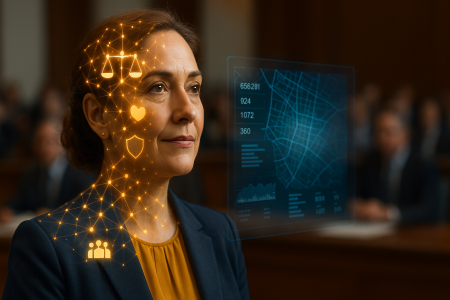
Artificial intelligence (AI) has entered public life with transformative force. Around the world, governments are deploying algorithmic systems to enhance services, optimize decisions and anticipate societal needs. In effect, AI is granting institutions, and those who lead them, a kind of technological “superpower”: The capacity to process vast volumes of data in seconds, automate complex tasks, predict citizen behavior and detect patterns invisible to the human eye.
These capabilities are especially valuable in times of uncertainty and institutional stress. During the COVID-19 pandemic, for example, some governments used AI models to trace transmission chains, allocate healthcare resources and anticipate outbreaks—demonstrating the practical potential of machine learning in life-critical contexts. Beyond health, AI has been applied to flag irregularities in procurement, anticipate infrastructure failures and personalize public services.
In this context, several authors have described how these technological superpowers might be applied in the public sector. In my previous columns, Superpowers for Public Servants in the Age of Artificial Intelligence, Part I and Part II, I proposed a framework of seven AI-enabled capacities that could empower public servants in this new era:
- Expanded Vision — perceiving risks, opportunities and needs through real-time analytics.
- Infallible Decision-Making — decision-support systems that enable faster, more accurate choices.
- Omnipresent Presence — extending the reach and responsiveness of public institutions.
- Empathetic Communication — tailoring messages for diverse audiences with AI tools.
- Superhuman Efficiency — automating routine bureaucratic tasks.
- Algorithmic Justice — detecting and addressing bias in decision systems.
- Predictive Governance — anticipating social trends to guide proactive policy design.
These capacities are already reshaping how public services are organized and delivered. Yet a subtle risk lies in today’s enthusiasm for technology: assuming these capabilities can replace the deeply human powers that have long guided public service—empathy, ethical judgment, political imagination, active listening and a steadfast commitment to the public good. These are human superpowers—indispensable qualities no algorithm can replicate.
As Henry Kissinger, Eric Schmidt and Daniel Huttenlocher argue in The Age of AI: And Our Human Future, AI does more than accelerate knowledge; it reshapes how we understand causality, reality and truth. While it can support better-informed decisions, it cannot assume the moral responsibility that underpins public choices. Fairness, dignity and justice must be actively interpreted and defended—by humans.
This point is echoed in the UK Committee on Standards in Public Life’s report Artificial Intelligence and Public Standards, which notes that trust in public institutions will depend not on technical precision alone, but on the transparency, accountability and ethical standards of those who deploy the technology. Algorithms do not confer legitimacy. People do.
The tension between the technical and the human is not new—but it is more urgent. In public administration, where legitimacy derives not only from efficiency but also from perceived fairness and civic trust, the danger is over-delegating judgment to machines. Public servants remain essential as ethical agents—interpreting complexity, navigating ambiguity and balancing competing interests with a sense of justice and responsibility.
This challenge is also an opportunity: to integrate AI in ways that reinforce human strengths rather than replace them. AI may deliver efficiency and foresight, but only public servants can exercise empathy in a community forum, compassion in the face of injustice or prudence when laws and values come into tension.
These are the human superpowers to strengthen in the digital age. They are not merely technical skills, but moral, emotional and civic capacities that shape how we use the tools we create. As access to AI becomes widespread, what will distinguish excellent public service is the judgment, purpose and ethics that guide its deployment.
The goal is not to choose between artificial and human intelligence, but to combine both wisely. As the World Economic Forum’s Jobs of Tomorrow: Mapping Opportunity in the New Economy highlights, the most valued skills in future economies will be hybrid: systems thinking, creative problem-solving, emotional intelligence and collaborative leadership.
Urs Gasser and Viktor Mayer-Schönberger make a similar case in Guardrails: Guiding Human Decisions in the Age of AI: governance must go beyond technical standards to include institutional mechanisms and a democratic culture that elevate reflection and ethical deliberation. Without this, innovation risks drifting away from the public interest it claims to serve.
In short: AI can give us speed, scale and precision. Only our human superpowers provide purpose, moral direction and civic legitimacy. The future of public institutions will depend not just on how well they adopt emerging technologies, but on how wisely they combine them with the enduring strengths of human judgment.
Technology should not replace what makes us human—it should amplify it. In a world where algorithms can predict, it is still up to public servants to decide. Increasingly, they must do so with wisdom, empathy and integrity—the true superpowers of our time.
Author: Mauricio Covarrubias is Professor at the National Institute of Public Administration in Mexico. He holds a Ph.D. from the National Autonomous University of Mexico (UNAM) and completed a postdoctoral fellowship in Government and Public Policy at the University of New Mexico in Albuquerque. He is co-founder of the International Academy of Political-Administrative Sciences (IAPAS). He can be reached at [email protected] and followed on X (formerly Twitter) @OMCovarrubias.
 (5 votes, average: 5.00 out of 5)
 Loading...
Follow Us!