Widgetized Section
Go to Admin » Appearance » Widgets » and move Gabfire Widget: Social into that MastheadOverlay zone
Measuring Trust in Collaborative Governance
The views expressed are those of the author and do not necessarily reflect the views of ASPA as an organization.
By Denise Hendrix
November 24, 2025
Introduction
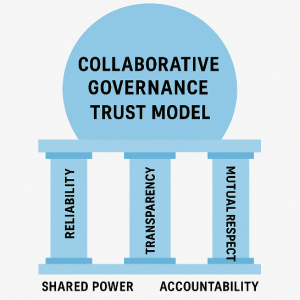
Public administrators continue to confront mounting challenges: the erosion of public trust, institutional fatigue, and complex social problems that defy siloed solutions. In last month’s column, I introduced the Collaborative Governance Trust Model (CGTM), built on three core pillars, reliability, transparency, and mutual respect, as foundational elements of public collaboration. This follow-up explores how organizations can evaluate these pillars over time, measure the impact of trust on outcomes, and apply the model flexibly across diverse institutional settings. It also highlights the supporting roles of shared power and accountability, which, while not formal pillars, are critical to sustaining effective and equitable collaborative governance.
Trust Is a Moving Target—Let’s Measure It That Way
Trust is not a one-time achievement. It evolves, matures, or erodes based on experience and consistency. The CGTM recognizes trust as a dynamic quality built on three key attributes: reliability, transparency, and mutual respect.
Public institutions can assess progress through a simple evaluation framework that aligns these pillars with activities and outcomes. For example:
– Reliability: Consistent delivery on promises, timely follow-through, adherence to agreements
– Transparency: Accessible communication, data sharing, and clear expectations
– Mutual Respect: Listening to diverse voices, affirming dignity, and honoring cultural context
These can be tracked with indicators such as response times, stakeholder feedback, service delivery consistency, and engagement satisfaction. When embedded into organizational learning, this assessment process can illuminate gaps and prompt responsive adaptation.
From Process to Policy: Why Outcomes Matter
Trust-building is not a passive process; it must yield results. In complex governance challenges like homelessness, trust is often the determining factor between policy intent and policy impact.
Consider New York City’s cross-sector response to housing instability. When agencies and nonprofits establish reliable partnerships, maintain transparent coordination, and demonstrate mutual respect toward service recipients, their efforts are more likely to result in sustained housing placements and policy compliance. Without those pillars, even the best-funded programs struggle to gain traction.
Shared Power and Accountability: Reinforcing Trust
Though not labeled as core pillars in the model, shared power and accountability are essential for putting trust into action. Shared power ensures that collaboration is not extractive, that community voices aren’t just heard but integrated into policy design. Accountability ensures that public actors are answerable to one another and to the people they serve.
Institutions can strengthen both by codifying co-governance structures (such as advisory councils or steering committees) and adopting transparent performance reporting. These practices reinforce trust by proving that influence and oversight are shared, not hoarded.
Institutional Adaptability
The model is designed to be adaptable. In local government, it may guide interdepartmental cooperation. In nonprofits, it may shape donor and client trust. Faith-based organizations may apply it to align community outreach with moral and ethical imperatives. While the setting varies, the trust pillars remain universal.
Conclusion: Evaluating What We Value
Trust, built on reliability, transparency, and mutual respect, must be measured and cultivated like any other strategic asset. By embedding this model into public work, and supporting it with shared power and accountability, institutions move beyond performative collaboration. They position themselves to deliver real outcomes rooted in legitimacy, equity, and long-term public confidence.
Evaluating these trust pillars is not just an internal management practice, it can be a public commitment to accountability and learning. Publishing these assessments in accessible formats or discussing them during community forums can help rebuild relationships with skeptical or disengaged populations. Over time, these evaluations also become critical sources of institutional memory, capturing both what worked and what was learned.
In complex systems, reliability isn’t just about punctuality or delivery, it’s about dependability across time, space, and leadership changes. When staff turnover occurs, programs evolve, or funding shifts, consistent values and follow-through can reinforce institutional trust even amid disruption.
Similarly, transparency must go beyond data dumps or polished messaging. It requires agencies to be open about uncertainty, limitations, and trade-offs, the very realities that define public administration. Honest communication doesn’t erode trust; it’s often the foundation of it.
Mutual respect also demands internal reflection: are our policies rooted in equity and justice? Are our decision-making tables diverse and inclusive? Respect means more than politeness; it reflects the structural dignity we extend to communities in every policy we implement.
As we move into an era shaped by climate disruptions, social justice movements, and economic volatility, collaborative governance will not be a luxury, it will be a necessity. Frameworks like the CGTM equip institutions to meet those moments not with control, but with coordination and courage.
Looking ahead, public administrators must be equipped to lead with integrity and humility. Trustworthy institutions do not claim perfection, they demonstrate a willingness to learn, evolve, and include. In that spirit, the Collaborative Governance Trust Model offers more than a framework; it presents a mindset shift. It challenges us to view governance not as command and control, but as a shared endeavor rooted in listening, partnership, and sustained public value. By intentionally embedding trust as both a guiding principle and a performance metric, we make room for government to be not only effective, but truly just.
Author: Dr. Denise Hendrix is a public administration professional with expertise in collaborative governance, homelessness policy and nonprofit public sector partnerships. With a background in both scholarship and practice, Hendrix focuses on improving system coordination and empowering middle managers in human services. Contact: [email protected]
 (1 votes, average: 5.00 out of 5)
 Loading...
Follow Us!