Widgetized Section
Go to Admin » Appearance » Widgets » and move Gabfire Widget: Social into that MastheadOverlay zone
On My Desk: Metamodern Public Administration


The views expressed are those of the author and do not necessarily reflect the views of ASPA as an organization.
By Grant E. Rissler
November 21, 2025
Among the recent articles published in Administrative Theory & Praxis (ATP) is Metamodern public administration: Contending with traditionalism, modernism, and postmodernism. The article contrasts the philosophies of traditionalism, modernism and post-modernism, summarizing how each contains drawbacks for confronting the complexity of evolving public administration challenges and introduces metamodernism as a potential improvement that draws pragmatically from both modernism and post-modernism. The article provides an introduction to this alternative philosophy and encourages public administrators to explore how it might be operationalized.
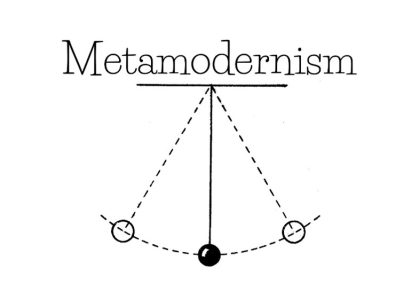
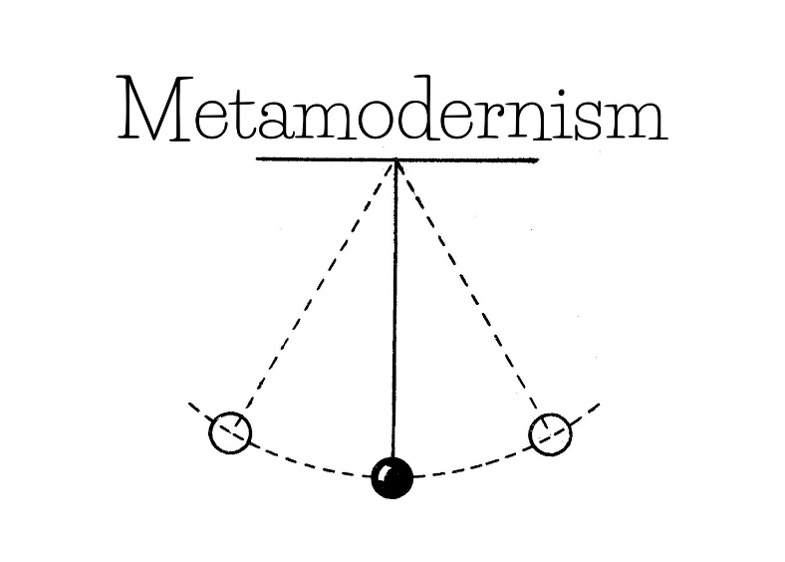
In their recent article “Metamodern public administration: Contending with traditionalism, modernism, and postmodernism” in Administrative Theory & Praxis (ATP), Christopher Tyler Burks & Derek R. Slagle introduce metamodernism, defined as “a constant oscillation between modernist optimism and postmodernist skepticism”, as a potential improvement and support for adaptive leadership, compared to the dominant philosophies embedded in the evolution of public administration thought to date (i.e. traditionalism, modernism and post-modernism).
Insights from the Article
The authors argue that this “pragmatic move” allows space for the creation of “dynamic policy frameworks that embrace complexity,” eschewing fixed solutions in favor of a combination of long-term ideals and short-term pragmatic adjustments in the face of feedback and shifting context. These “multidimensional policy designs” developed with a metamodernist appreciation of diverse cultures, identities and epistemologies allow the conceptual frameworks of public administrators to match in complexity current issues like immigration, education or healthcare “by acknowledging the multiplicity of cultural, racial and socioeconomic factors at play.” Though Burks and Slagle categorize his work as post-modern, the oscillation described is deeply reminiscent of David Farmer’s invitation to public administrators in his 2005 book, To Kill the King, to reorient outward toward “the individual-in-herself in-her-difference.”
To make the application of insights more concrete, the authors also apply the metamodern perspective to the issue of homelessness, contrasting it to the approaches of traditionalism, modernism and postmodernism. For example, compared to a modernist approach that might emphasize government-managed housing and job training programs that are efficient, scalable and empirically grounded, and a post-modern approach that would empower grassroots initiatives and challenge dominant systems, the metamodernist emphasis would be on an adaptive systemic response that blends centralized efficiency with localized empathetic interventions.
Applying the Framework to Immigration
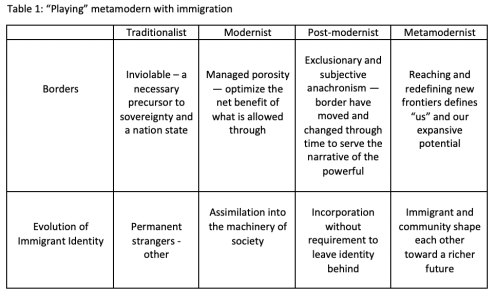
In the spirit of another of Farmer’s invitations, thinking as play, reading Burks and Slagle’s exploration of what a metamodern perspective on homelessness policy might be inspired doing the same with aspects of immigration policy, and two dimensions of that issue come immediately to mind, borders and identity. The table below highlights how differently one could argue that these philosophies approach the concepts.
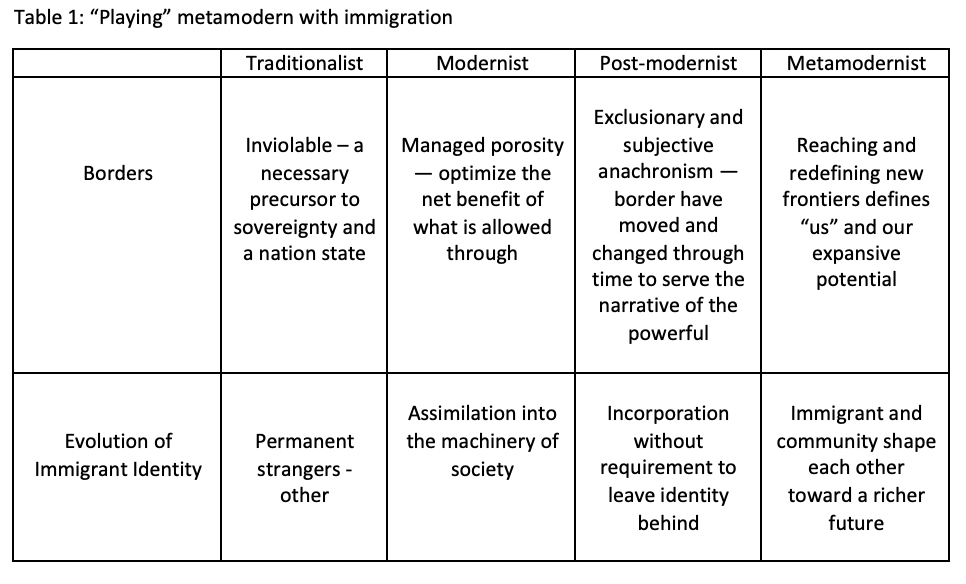
Recognizing that the above is not serious philosophy but a skittering playful waterbug on the surface of a deep issue, the throughline that emerges, as the authors note, is for a metamodernist approach “where disagreements are transcended, not reconciled,” inviting ways to weave multiple perspectives into an imagination of a positive future. In fact, that insight seems at least a cousin of peacebuilding theorist John Paul Lederach’s observation that finding ways out of deep-seated conflict often requires “the moral imagination” as the art and soul of peacebuilding.
Conclusion
While the authors acknowledge that future research is needed to translate metamodern principles into tangible policies and practices, the article provides a basis for ongoing and optimistic engagement with ways that public administration “can evolve to meet the demands of an increasingly fragmented, yet interconnected world.”
Author: Grant Rissler is Assistant Professor of Organizational Studies at the School of Professional and Continuing Studies, University of Richmond (VA). He serves on the editorial board of Administrative Theory & Praxis (ATP) and focuses his research on social equity and peacebuilding with particular interest in local government responsiveness to immigrants. The “On My Desk” series of columns, begun in July 2024, highlights the insights of one or more articles published in ATP in relation to a current debate or event. Grant can be reached at [email protected].
 (No Ratings Yet)
 Loading...
Follow Us!


Christopher Tyler Burks
November 21, 2025 at 3:17 pm
Great read! Glad to see this application of metamodernism to immigration policy.