Widgetized Section
Go to Admin » Appearance » Widgets » and move Gabfire Widget: Social into that MastheadOverlay zone

Proportional Representation (PR) — Possible Solution to Gerrymandering and Partisan Re-Districting?


The views expressed are those of the author and do not necessarily reflect the views of ASPA as an organization.
By Stephen R. Rolandi
December 15, 2025
“The pure idea of democracy, according to its definition, is the government of the whole people, equally represented.” – John Stuart Mill (1806–1873), political philosopher, Member of Parliament, writer and author of Representative Government (1861)
In preparation for my article in this month’s edition of PA Times, I have been following the “redistricting wars” currently underway in many states, begun this past summer, where several state legislatures have attempted to redraw their congressional district boundaries ahead of next fall’s U.S. House of Representatives elections.
While also understood as gerrymandering, which can be traced back to the early 19th century and employed by both political parties, these recent efforts mark one of the largest coordinated attempts to redraw congressional districts in modern American political history.
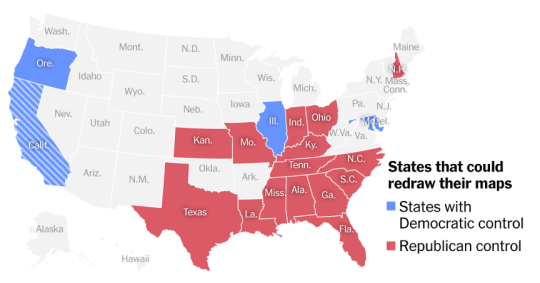
The chart below, published by The American Habit on August 16, 2025, shows which states have begun to realign their congressional districts to maximize their position for the crucial 2026 mid-term elections. Usually, redistricting occurs every ten years following the decennial census.
As we get closer to the mid-term elections, these efforts can be expected to intensify, as the current political party lineup in the House of Representatives (220 Republican, 213 Democratic, 2 vacancies) is very tight, and a swing of a few seats in the next election will determine which party controls the House and elects the next Speaker of the House, currently second in the line of succession to the presidency:
Observers of the current redistricting battles point to several criticisms of these efforts:
- Voter disenfranchisement and confusion;
- Politicians picking constituents and not the other way around;
- Reduced accountability and competitiveness;
- Erosion of democratic norms;
- Increased partisanship and gridlock;
- Legal and judicial chaos.
Fortunately, there is another way for political parties to select their candidates for U.S. House seats, and that is by utilizing a form of proportional representation (PR), which was espoused by the British philosopher John Stuart Mill when he wrote Representative Government.
Proportional Representation
We can define proportional representation (PR) as any electoral system by which different subgroups of an electorate are represented proportionately in an electoral body, particularly a legislature. The aim of PR systems is that all votes cast contribute to the result so that each representative in an assembly is mandated by a roughly equal number of voters. Therefore, all votes would have roughly equal weight. PR systems aim to achieve balanced representation in relation to a party’s share of the popular vote. Many nations around the world, including the European Union legislature, employ some form of proportional representation.
A PR electoral system is distinguished from single-member plurality systems, currently in use in the United States for most legislative seats at the federal, state and local levels. A PR system is also different from systems in which members of a legislative body are elected by an entire electorate as opposed to a subset of voters. For example, in some U.S. House delegations there is only one representative assigned to a state by population, such as Alaska and Wyoming.
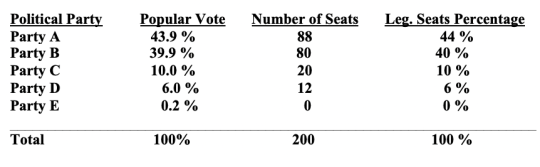
Here is an example of a basic PR system used to elect representatives to a nation’s national legislature with 200 members:
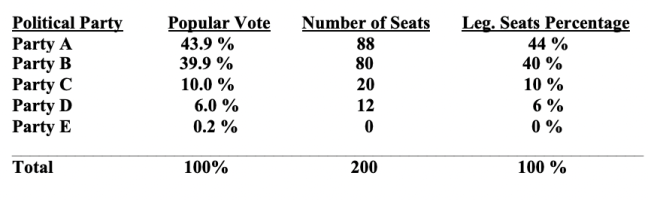
In this example, no party achieved a majority of the popular vote or a majority of legislative seats, so a coalition of parties would need to be formed to establish a governing majority. If a majority could not be achieved, depending on the nation’s laws, a new election would need to be called, or the president, as head of state, would appoint a prime minister from one of the political parties, usually though not always the leading party in the legislative chamber.
Common types of PR electoral systems
- Closed list systems: each party lists its candidates according to its selection process. This sets the order of candidates on the list and, in effect, the probability of being elected. The first candidate on the party list receives the first seat that party wins. A party is allocated seats in proportion to the number of votes it receives.
- Open list systems: voters may vote, depending on the model, for one person or for two or more, or vote for the party list while indicating their order of preference within the list.
- Two-tier list systems, used in Denmark, Norway, Finland and Sweden. Here, voters have one vote cast for an individual candidate. To determine district winners, parties are allocated district seats based on their district vote shares. A compensatory representation method is also used to award seats to regions according to the party share received nationally.
It should be noted that some PR systems allow voters to indicate their first, second and third choice of candidates. A candidate who achieves the minimum number of votes for election is declared the winner of the first seat, and excess votes are transferred to the second-choice candidate and so on until the full assembly is elected. Such a system was in place in New York City from the 1970s through the 1990s to elect local community school board district members.
Some conclusions: Would PR work in the United States?
Changing an electoral system would require the agreement of a majority of members in a legislative body who were presumably chosen using an incumbent single-member district system. Therefore, the more interesting question is what incentives would lead a current legislator to support a new electoral system utilizing some version of PR. It might theoretically work if a legislature mandated such a system for a future legislative body.
Political scientists who have studied this question point to some countries’ right-wing and left-wing parties advocating for PR as a way to gain a foothold in national legislatures and national politics, such as the AfD Party in Germany.
A PR system would not work in a state with only one congressional representative. A third party would likely support such a system, as it would give it an advantage in dealing with the two major parties, Democrat and Republican.
For now, I do not personally see PR being adopted for American congressional elections. My view is that political parties fare better when they field stronger candidates and advocate more moderate views, as opposed to altering the rules of the game by repeatedly changing district lines until the next census.
How will this all play out? As is true in most things in life, time will tell.
Author: Stephen R. Rolandi retired in 2015 after serving with New York State and New York City. He holds BA and MPA degrees from New York University and studied law at Brooklyn Law School. He teaches public finance and management as an adjunct professor of public administration at John Jay College of Criminal Justice (CUNY) and Pace University. Professor Rolandi is a trustee of NECoPA and the New Amsterdam History Center, president emeritus of ASPA’s New York Metropolitan Chapter and a past senior National Council representative. He has served on many association boards and is a frequent guest commentator on public affairs and political issues facing the nation and New York State. You can reach him at: [email protected]; [email protected]; 914.441.3399; 212.237.8000
 (No Ratings Yet)
 Loading...
Follow Us!