Widgetized Section
Go to Admin » Appearance » Widgets » and move Gabfire Widget: Social into that MastheadOverlay zone

Reality, Challenges and Opportunities facing the Next Mayor of New York City
The views expressed are those of the author and do not necessarily reflect the views of ASPA as an organization.
By Stephen R. Rolandi
September 15, 2025
“What is the city but for the people?” — William Shakespeare (1564-1616), English playwright and poet
“The chief function of the city is to convert power into form, energy and culture, dead matter into the living symbols of art, biological reproduction into social creativity.” — Lewis Mumford (1895-1990), American historian, sociologist and writer on urban planning and urban architecture
I often tell students in my undergraduate and graduate public administration classes that cities are not mentioned in the United States Constitution, as the Constitution was an agreement between the new Federal government and the states.
And yet, cities (or more precisely defined as urban areas) have played a large part in the historical development of the United States. It was cities that attracted large numbers of immigrant families to come to America in search of opportunity and a better way of life.
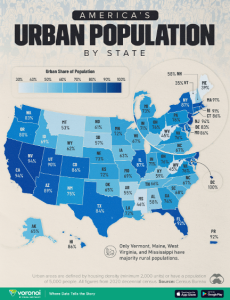
According to the last decennial census, the great majority of the nation’s population live in urban areas, as the chart below (data derived from the 2020 Census).
The study of cities and urban problems as well as their politics forms a large part of the study of American government and public administration. This election year (2025) is considered to be an “off year election,” as municipal elections occur before next year’s Congressional midterm elections and the 2028 Presidential election. Municipal elections will be held in scores of American cities including Boston, Detroit, Miami, Oakland, Jersey City (NJ), Pittsburgh, San Antonio, Seattle, and of course my hometown and former employer, the City of New York, the focus of this month’s column.
New York City has the distinction of serving as the first capital city of the young United States of America when George Washington became President in 1789. What we know today as the City of New York came about in 1898 when the New York State Legislature approved a consolidation plan of the “greater city” to include not only Manhattan but also the City of Brooklyn, Staten Island, and the various towns comprising the counties of Queens and The Bronx. Today, the City’s population stands at 8.5 million residents (down slightly from 8.7 million in 2020) with a projected population of 9.1 million by 2030.
The chief executive of the consolidated city is the Mayor of the City of New York, elected by all the voters of the City in the odd-numbered year following the Presidential election. Voters in the general election select candidates nominated by the established political parties in New York State (Republican Party, Democratic Party, Conservative Party of New York State and Working Families Party) as well as independent candidates who must successfully petition for the ballot.
The current City expense (operating) budget is nearly $116 billion, which makes it larger than most states and many nations around the world. Its local revenue sources (over 80%) come from local taxes, fees and permits. The balance comes from external sources, chiefly from the Federal government of the United States and State of New York for housing, education, social services, transportation and economic development. To leverage many of these grants, the City has to allocate a certain portion of its tax-levy expense budget toward the Federal and State grants.
New York City is the financial, media and international capital of the world, and its Mayor commands much media attention (as was seen in the aftermath of the September 11 attacks when then New York City Mayor Rudy Giuliani was hailed as “America’s Mayor”). Past NYC Mayors in the last 75 years have unsuccessfully sought higher elective office. It seems paradoxical that many ambitious politicians over the years have sought the Mayoralty, even though it has proven to be a “dead end” politically.
Despite the veneer of great prestige, the Mayor has a limited range of power; while the Mayor can and does appoint most of the upper-level commissioners and managers, he relies on the State government (and to a certain extent, the Federal government) for funding and authority to impose taxes, particularly income and sales taxes.
Being Mayor is not just about solving problems but also keeping the City at the height of innovation, aspiration and cutting edge. The State’s Governor and Legislature in Albany have more power, which is a reality check for the one who sits in the Mayor’s chair.
The next Mayor will face a myriad of issues:
Public Safety: In the last five years since the COVID-19 pandemic, public safety as measured by crime statistics seems to be slowly improving, but many New Yorkers feel less safe than previously, particularly in the City’s subway system.
Housing & Affordability: In a city where two-thirds of its residents are renters, the soaring cost of housing is perhaps the biggest threat to the City’s future. In the first quarter of 2025, for example, median rent stood at $3,397 per month, a nearly 20% increase from 2020 (source: Realtor.com). From 2011 to 2023, the City added 353,000 housing units, with a vacancy rate for rentals of just 1.4%. At the same time, the poverty rate was nearly double the national average (2023). This means that while the cost of housing is causing pain for renters of all but those in the upper income brackets, for thousands of New Yorkers it is potentially leading to homelessness.
Budgets and Funding: The City was able to cover operating budget deficits the last two years by transferring surplus funds from prior years. The current financial plan projects budget gaps of $5-$6 trillion per year for Fiscal Years 2027-2029, and this is before the strong possibility of Federal budget cuts from the Donald Trump 2.0 Administration, which would exacerbate these deficits. How would the City balance these out-year budgets? The next Mayor will have to face difficult choices in achieving recurring budget balances and maintain the City’s strong credit rating.
Governance/Charter Revision/Agency Operations: The next Mayor may very well have to consider ways to make the city administration more “lean and mean,” which unfortunately the current incumbent and his immediate predecessor were not able to do.
These are just some of the major challenges awaiting the next occupant of Gracie Mansion come January 1, 2026. It will require bold leadership and making hard choices in the years ahead.
Author: Stephen R. Rolandi retired in 2015 after serving with the State and City of New York. He holds BA and MPA degrees from New York University and studied law at Brooklyn Law School. He teaches public finance and management as an Adjunct Professor of Public Administration at John Jay College of Criminal Justice (City University of New York) and Pace University. Professor Rolandi is a Trustee of NECoPA and the New Amsterdam History Center, President-emeritus of ASPA’s New York Metropolitan Chapter and past Senior National Council Representative. He has served on many association boards and is a frequent guest commentator on public affairs and political issues facing the nation and New York State. You can reach him at: [email protected] or [email protected] or 914.441.3399 or 212.237.8000.
 (No Ratings Yet)
 Loading...
Follow Us!