Widgetized Section
Go to Admin » Appearance » Widgets » and move Gabfire Widget: Social into that MastheadOverlay zone
Reclaiming Public Service: A Call to Restore Government
The views expressed are those of the author and do not necessarily reflect the views of ASPA as an organization.
By Charles Mason
July 11, 2025
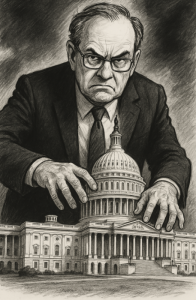
At the heart of American public administration lies a noble ideal: government by the people, for the people. Yet in the modern era, the administrative state has drifted dangerously from this principle, expanding its power, size and distance from those it is supposed to serve. What was meant to be a system of accountable, transparent governance has metastasized into a sprawling, self-sustaining bureaucracy that often operates beyond the reach of democratic oversight.
Today, the federal workforce is vast—approximately 2.2 million civilian employees—and yet the number tells only part of the story. Federal agencies, through their layers of administrative rules and regulatory authorities, now touch every corner of American life, from how farmers manage their land to the substances allowed in household products. And while agencies were initially designed to be stewards of the public good, they increasingly act as autonomous rulers, with their insulated ecosystems, priorities and ideologies.
Career civil servants are not inherently bad people, but a system that allows unelected bureaucrats to create, enforce and interpret regulations with the force of law—without meaningful input from the electorate—erodes the very foundation of representative democracy. The issue is not individual competence or intent. The issue is that the administrative state has grown so large, so complex and so self-reinforcing that it no longer serves the people—it serves itself.
The disconnect between the bureaucracy and the American people is more than a talking point; it is a structural flaw. Bureaucrats do not answer to the ballot box. The average American can vote for their president, their representative in Congress and their senator. Still, they cannot vote for the regulatory officials who will shape the policies governing their healthcare, energy use, education and livelihoods.
Many defenders of the administrative state argue that expertise demands insulation from public opinion. But this argument betrays a fundamental misunderstanding of American governance. Expertise is valuable, but it cannot override the principle of consent of the governed. Expertise should inform policy, not dictate it. The power to make binding decisions must remain with elected officials who can be held accountable for their actions.
In reality, the administrative state often functions as a fourth branch of government—writing, enforcing and adjudicating its own rules. Consider how the Environmental Protection Agency (EPA), the Food and Drug Administration (FDA) and the Federal Communications Commission (FCC) routinely issue regulations that carry the full weight of law, despite having never passed through Congress. Regulatory rulemaking has effectively replaced legislation, concentrating power in agencies that the public cannot easily challenge or dislodge.
Furthermore, agencies have developed a skill in resisting political leadership. It is not uncommon for career officials to slow roll, obstruct or dilute the policies of elected administrations with which they disagree. Even when the presidency changes hands, the bureaucracy often remains ideologically committed to its own long-standing priorities. The will of the people becomes a temporary nuisance, a passing storm to be weathered until the next election cycle.
This is not an abstract concern. Recent years have shown how agencies can wield immense influence to shape public discourse and policy outcomes. Agencies have coordinated with social media platforms to suppress dissenting views, selectively enforced regulations against political adversaries and expanded their own jurisdictions without explicit congressional approval. This behavior does not reflect a healthy democracy—it reflects a bureaucratic oligarchy.
Some argue that deregulation is the enemy—that reducing the government’s footprint harms public welfare. But what deregulation truly represents is the restoration of freedom: the freedom to innovate without being entangled in excessive red tape, the freedom to build without navigating Byzantine approval processes, the freedom to live without the constant hand of the government steering every decision.
To reclaim our government, we must recenter it on its constitutional purpose. The goal is not to destroy public administration but to bring it back within its rightful limits. This means reducing the size of the federal workforce, eliminating redundant agencies and reasserting congressional responsibility for legislation. It means increasing transparency, shortening bureaucratic tenure and establishing pathways for citizen review and accountability.
Civics education is essential, but it should teach Americans how to hold their government accountable rather than instilling a blind trust in bureaucratic benevolence. The ideal of career civil servants who loyally serve the Constitution is noble, but the system must ensure that their service is tethered to the will of the people, not insulated from it.
When unelected administrators can make binding decisions that affect every aspect of life without the consent of the governed, the republic is in danger. This is not about attacking individuals; it is about dismantling an entrenched structure that no longer serves its intended purpose.
The promise of America was never governance by distant experts; it was governance by neighbors, by fellow citizens, by those who can be removed if they betray the public trust. To restore that promise, we must shrink the bureaucratic state, return power to the people and insist once again that this is a government of the people, by the people and for the people.
Author: Charles Mason, Ph.D., is a graduate of Walden University in Public Policy and Administration specializing in Criminal Justice. He is also a graduate of Barry University with an MPA and a graduate of Vincennes University with a Bachelor of Science in Homeland Security and Public Safety. He has over 30 years of experience in security, local law enforcement, state corrections and military service. He is currently the president of Mason Academy. He can be reached at [email protected]. Twitter: https://twitter.com/DRCharlesMason


 (6 votes, average: 2.67 out of 5)
 Loading...
Follow Us!