Widgetized Section
Go to Admin » Appearance » Widgets » and move Gabfire Widget: Social into that MastheadOverlay zone
Some Implications of Censorship of Equality and Equity in Policy and Public Administration Courses
The views expressed are those of the author and do not necessarily reflect the views of ASPA as an organization.
By Christopher Koliba
July 21, 2025
State legislatures across the United States are banning professional accreditation bodies from enforcing standards relating to equity, diversity and inclusion (DEI) provisions in accredited degree programs’ operating and educational missions, including those offered within public administration. This DEI strawman is a direct assault on democratic liberty and professional integrity. Efforts to ban anything related to diversity, equity, equality and inclusive practices amount to state meddling in the affairs of a profession.
As a professor of public administration and public affairs, I am charged with educating the next generation of public servants. My students come from a variety of backgrounds and political ideologies; my classrooms serve as spaces for open debate and considering matters of policy design and implementation. The potential threats that result from policing the types of words employed and topics covered in our courses impose a level of unprecedented state control and surveillance, which is exactly what is happening to educators in some states around the country. These are actions of authoritarian states, not democratic ones.
When the state censors how my students and I weigh policy option trade-offs, it undercuts our ability to clearly and reasonably consider and evaluate them. And in so doing, it damages democratic standards and public administration’s ability—and others like it relating to law, medicine, social work, education, counseling, engineering and business administration—to manage and enforce codes of ethics and conduct that have been long-standing features of these professions. Standards and codes that have allowed these professions to serve the needs and interests of all Americans. Placing bans on programmatic focus on equity, equality, diversity and inclusion violates a professional association’s First Amendment rights to set its own standards. These states’ efforts to ban the use of specific words strike at the heart of a profession’s ability to self-regulate and erode the public trust that has long existed between democratic states and the professions.
As a professor who teaches students with varied political outlooks, prohibiting me and my colleagues from integrating equality and equity as valid policy goals in our curriculum undercuts the ability of my students and me to honestly and effectively evaluate the pros and cons of specific public policies.
Social equity is a policy goal associated with the relationship between individual liberty, rights and outcomes. Equity and equality, both words recently prohibited by the current presidential administration, are core criteria to be used by democratic societies to weigh policy and legal decisions.
Democracies are supposed to make sense of policy and legal considerations based on goals and providing public value. In the realm of democratic societies like ours, these goals are varied and often quite complicated to apply and assess.
We long have been a nation that values individual liberty and individual rights. This right allows me to write this editorial freely without fear of undue political or legal reprisal.
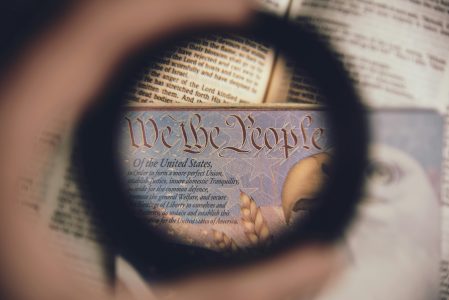
We task our governments with protecting, and in many instances advancing, individual rights. This task was outlined in the nation’s Declaration of Independence, embodied in the line that “all men are created equal” and clearly spelled out in the U.S. Constitution’s Bill of Rights. The assertion that all men are created equal, penned by Thomas Jefferson, indelibly weds individual rights to the ideal of equality.
One of the underlying rules of a democracy lies in the rights of all individuals to possess their own personal pathways to leading a good life. This ideal is deeply tied to our concept of the “American Dream.”
It is the role of the state in democracies like ours to protect us and our individual liberties. Democratic governments have a role to play in providing for our security. This is most clearly represented in the state’s law enforcement responsibilities but also, importantly, in our medical and social services systems. While we can and should debate the limits of state provision of security, expectations for baseline economic and health security (as represented in Social Security and Medicare for instance) are widely supported by the American public regardless of party affiliation.
While there are differences of opinion regarding the extent to which democratic states should be charged with offering a baseline level of welfare and fulfillment of basic needs, the idea that a democratic society is at least partly responsible for its people’s social welfare is irrefutable. There are countless examples of the welfare provisioning functions of democratic states, ranging from emergency management and disaster response to road safety and maintenance to providing clean drinking water and working sewage systems to access to education. The list goes on.
Democracies also need to be efficient. A government can do almost anything but it cannot do everything. Hard choices need to be made. Resources need to be allocated in a manner that is both efficient and effective. Efficiency is rooted in the basis of assessing costs and benefits. How we assign value to those costs and benefits has proven to matter a great deal. Equity, as a policy goal, needs to be understood in light of liberty, security, welfare and efficiency policy goals. Does someone have a right to equal treatment under the law? What happens to one’s security and welfare when equal treatment is violated? What is the government’s role in providing equal protection? Can the government afford to equally protect everyone? Which begs the question: equal protection against what? Someone’s right to due process? Someone’s right to equal access to a public good or service? Someone’s right to an equal outcome?
For a moment, separate the idea of equal outcomes from specific notions of social inequality broken down by identity (race, class, gender) and consider more broadly in what contexts should the equality of a policy outcome matter? Consider health care. Do we expect Medicare enrollees to be treated to different levels of health outcomes based on their age? We would be appalled if, as you were to reach a certain age, your health care were rationed. Recall concerns about the narrative of the federal government convening “death panels” to determine who would get rationed care. The ideal of health equity—that all people are entitled to equal health outcomes—gives us reason to consider the extent to which this ideal extends to all segments of society. To understand if this is the case, we need to look at data—specifically, the disaggregation of data at policy outcomes of certain segments or portions of society.
A concept like health equity matters to everyone. Do city dwellers receive better care than rural residents? We need to differentiate between members of society by disaggregating data based on demographic characteristics to ensure society produces some measure of equal outcomes for all. When outcomes are unequal, it is the state’s role to determine if such inequality is discriminatory and unacceptable.
I’m not suggesting where to draw that line. Doing so speaks to a fundamental judgment about who you deem is or is not worthy. Professionals who make a career out of providing public goods and services need to be concerned about the equality of processes and outcomes. To suggest that we cannot and should not focus on matters of equality and equity in our professional standards and education strikes at the heart of any profession’s code of ethics and conduct.
Concepts like equality and equity serve as critical dimensions of reasoning, as do concepts like liberty, security, welfare and efficiency when judging the merits of public policies, rules, regulations and laws. To prohibit us from having our students consider how policy makers at the policy design level and public administrators at the policy implementation level weigh options and trade-offs is essentially dictating what policy goals can and cannot be discussed in the classroom. This not only violates our free speech rights but also is censorship and state coercion. It runs roughshod over our country’s democratic principles.
Banning specific words, programs and practices from future generations of professionals’ educational opportunities undercuts society’s ability to generate the context for open debate, reasoned consideration and protection of individual rights for all.
Author: Christopher Koliba is the Edwin O. Stene Distinguished Professor at the University of Kansas School of Public Affairs and Administration (SPAA). His research interest lies in areas of democratic accountability and the governance of critical infrastructure applying networks and complex adaptive systems perspectives and methods. He is a Fellow of the National Academy of Public Administration. He can be reached at [email protected].
 (4 votes, average: 5.00 out of 5)
 Loading...
Follow Us!


Roger Hartley
July 23, 2025 at 6:36 am
Terrific and important article Chris. So many things are important this. Not just the fundamental topic of the censorship of social equity in state university systems but, importantly, its policy consequences. This goes to our history of rural electrification, distribution of WiFi, medical care, placement of parks and recreation…virtually every part of public service.