Widgetized Section
Go to Admin » Appearance » Widgets » and move Gabfire Widget: Social into that MastheadOverlay zone

The 2026 Risk Map: Eight Fault Lines to Watch
The views expressed are those of the author and do not necessarily reflect the views of ASPA as an organization.
By Thomas Young
October 24, 2025
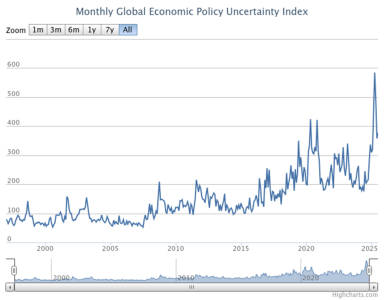
In about a month, virtually every investment bank, financial firm and economics consulting firm will release their outlook for 2026. Used mostly as thought leadership pieces and potential marketing opportunities, the thoughts expressed in these pieces can have real impact on economic policy. With that said, here are eight issues worth watching in the coming months as we enter a never-before-seen world of economic uncertainty.
- Debt overhang meets higher term premia
Public debt ratios and rollover needs are set to stay elevated just as long-maturity yields embed fatter term premia again—a combustible mix if growth disappoints. The IMF’s October Fiscal Monitor projects global public debt rising above 100% of GDP by 2029, warning that risks are “tilted” toward even faster accumulation without policy adjustment. In parallel, the IMF’s financial-stability briefings note term premia in benchmark sovereign markets have retraced to pre-GFC levels, heightening sensitivity to surprise inflation or supply shocks. The BIS similarly flags that high debt now leaves economies more vulnerable to adverse scenarios and raises the odds that interest-rate spikes propagate into financial stress.
Why it matters for 2026: heavier gross financing needs collide with less forgiving bond markets. Too much repricing skittishness could pull economic growth not just lower but below zero.
A bumpy soft-landing—if we get one
The latest IMF World Economic Outlook pegs global growth easing to approximately 3.1% in 2026, implying neither boom nor bust. The IMF’s prognosticators’ baseline hides an unhealthy asymmetry: advanced economies hover near 1.5% while EMDEs stay just over 4%. Upside and downside risks remain unusually wide given policy and trade uncertainty.
Why it matters: a modest-growth world offers little cushion if a shock hits—fiscal space is thinner and private balance sheets are interest-rate fatigued.
Financial-market fragility and an AI-moment rethink
The IMF warns of rising odds of a disorderly market correction as valuations in equities and credit (especially tied to AI enthusiasm) look stretched relative to fundamentals; a sharp repricing could reverberate through banks and leveraged nonbanks.Commercial real estate’s maturity wall
CRE faces a dense cluster of loan maturities through 2026. Industry trackers estimate a $1T to $1.5T U.S. debt wall through the end of 2026. While broad-based distress hasn’t erupted, office remains the weak link.Energy supply, geopolitics and the risk of price shocks
Short-run oil demand growth looks subdued into 2026 (approximately 0.7 mb/d y/y) but that doesn’t eliminate upside price risks from supply discipline, under-investment or geopolitical flare-ups.Food prices and climate volatility
Global food markets are calmer than the 2022 peak but pockets of vulnerability persist. FAO indicators show mixed moves across staples; the OECD-FAO outlook stresses that even modest global yield hits can drive sizable price spikes given thin stocks in some segments. In the U.S., food prices are on the rise again.Geoeconomic fragmentation and tariff aftershocks
Policy-driven trade frictions have multiplied. The World Bank’s Global Economic Prospects underscores how higher barriers and policy uncertainty sap medium-term growth; resolving current disputes could add back a few tenths to global GDP across 2025–26 but escalation would do the opposite.Diverging regional tracks—especially Europe and China
IMF projections imply the euro area mired near approximately 1% growth into 2026, with Asia still shouldering about 60% of global growth. The distribution matters: a sluggish Europe drags on global manufacturing and luxury demand; a slower-growing China weighs on commodities and regional trade even as Japan/Korea benefit from tech-cycle tailwinds.
Why 2026: persistent divergence complicates policy synchronization—FX swings and relative price changes can transmit quickly into trade balances and earnings.
What would turn these risks into realities?
A yield spike without growth: If inflation proves stickier and markets demand higher term premia, sovereign and corporate refinancing costs jump together, testing banks’ securities portfolios and the broader economy.
A confidence jolt in risk assets: An AI-led multiple compression or a funding squeeze in private credit could tighten financial conditions nonlinearly—especially with high debt and thin liquidity. Just think through this: U.S. GDP is about $30.5 trillion. If we expect growth of 4% next year (nominal dollars), then the U.S. economy will grow by $1.2 trillion. How much of that is AI? Well, when looking through companies’ reports, at least $400 billion of that could be AI, so a full third of growth is from AI. That’s exceptionally concentrated.
A supply-side shock: Oil or key food commodity supply disruptions would revive headline CPI, complicating central-bank easing and forcing pro-cyclical fiscal restraint.
Policy error and fragmentation: Escalating tariffs and export controls would depress investment and productivity just when potential growth is already sagging.
Bottom line
The 2026 outlook is not a doom call but a thin-ice equilibrium: moderate growth, elevated public and private debt and markets priced for a benign glide path. The most dangerous configuration is a supply shock (energy/food) that rekindles inflation while debt rollover intensifies. With buffers thinner and term premia back, policy discipline and risk plumbing matter more than ever.
Author: Thomas is an economist who works at the many intersecting touchpoints of economics, including think tank thought leadership, economic impact, financial economics, and economic forecasting. He did his Ph.D. in finance and economics from the University of Utah.
 (1 votes, average: 5.00 out of 5)
 Loading...
Follow Us!