Widgetized Section
Go to Admin » Appearance » Widgets » and move Gabfire Widget: Social into that MastheadOverlay zone

The Bond Prospectus: What It Is and What It Tells You
The views expressed are those of the author and do not necessarily reflect the views of ASPA as an organization.
By Richard F. Keevey
August 15, 2025
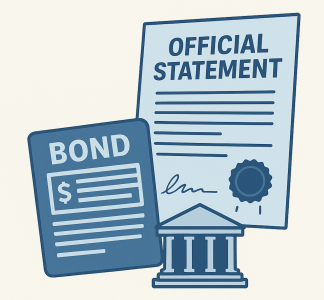
If one wishes to know the finances of a particular state or local government, do not first go to the annual budget or the annual financial statement or audit. Instead obtain the latest bond prospectus of the jurisdiction, sometimes referred to as the Official Statement (OS).
Its contents must meet certain disclosure standards set by the U.S. Securities and Exchange Commission (SEC), so its financial contents including pension obligations, pending legal claims, debt information as well as current audit, budget and tax data must be explicitly detailed and explained. No rosy projections or misleading statements are permitted or such presentations could lead to unpleasant discipline.
Now, if it is a small jurisdiction that issues few bonds, its currency and need is limited. But all states and most municipalities and school districts especially large ones sell bonds frequently. Each OS contains revised current and historical financial information as well as a wealth of other related information about the jurisdiction. More details shortly about those contents, but first what is a bond prospectus and who are the players in the process?
A prospectus (known as OS) is the document prepared in conjunction with the sale of bonds to provide information to prospective purchasers of those bonds. An OS is prepared by the government for the sale of corporate and municipal bonds.
Our focus is on municipal bonds which includes debt issued by a non-federal unit of government such as a state, municipal, county or public authority. Bonds can be sold on a competitive or negotiated basis. The pros and cons of each option would require extensive discussion including the purpose of the proceeds, the structure of the sale, the maturities, the timing of the sale, bid opening and awarding procedures and other rudimentary elements. General Obligation bonds (GO) must be sold competitively but revenue bonds can be and usually are sold on a negotiated basis.
There are other players in the process, but two are crucial—bond counsel and rating agencies. Bond counsel is a specialized and independent lawyer or law firm. The responsibilities and the role of bond counsel has a long history but suffice to say bonds cannot be sold without a favorable opinion of bond counsel. In short bond counsel must conclude that the government has followed all the correct procedures for issuance and has fully disclosed all relevant financial information about the government issuing the bonds.
A rating agency is the other major player. There are three principal rating agencies—Moody’s, Standard and Poor’s and Fitch. Each issuer pays for the rating from one or all of the agencies. The rating is intended to provide an independent assessment of the relative creditworthiness of the debt obligation in the market. The rating is based on information contained in the OS as well as the agency’s independent assessment. All things being equal the higher the credit rating (AAA) assigned to the bonds offering the lower the interest rate bid; likewise, a lower credit rating (A- or BBB) would signal greater risk to the buyer leading to a higher bid and a higher cost to the government.
For all practical purposes it would be very difficult for a government or corporation to sell a bond without a credit rating.
- There are usually six major components to an OS and usually 15 sub-components. The details of these components would require extensive discussion and listings but for our purposes consider some items of information in the OS:
- what the bonds are used for and the source of payment to the bond holder
- bond counsel’s legal opinion; bond rating and tax matters (federal tax exemption and the like)
- description of the government’s budget and accounting procedures and recent audit
- summary of revenue, appropriations and surplus over the past five years and current economic outlook
- listing of all outstanding debt by purpose and debt service projections
- employee counts including status of contracts and negotiations
- status of pension funding including policy and the status of funding levels
- pending litigation
- narrative description of major taxes
While not exactly light reading, the Official Statement (OS) is the most comprehensive, up-to-date and readily available source of general and specific information about a government’s financial and economic condition.
Author: Rich Keevey held two presidential appointments (one with Senate confirmation) as Deputy Under Secretary of Defense and Assistant Secretary and CFO at HUD. He was appointed State Budget Director by two NJ governors from each political party. He was Executive Director of the Policy Research Institute at Princeton University. Currently he is a Senior Policy Fellow at Rutgers University. He was the Executive Officer of a nuclear missile unit in Germany in the mid-1960s.
 (No Ratings Yet)
 Loading...
Follow Us!