Widgetized Section
Go to Admin » Appearance » Widgets » and move Gabfire Widget: Social into that MastheadOverlay zone
The Fall 2025 Shutdown Should Have Been Avoided
The views expressed are those of the author and do not necessarily reflect the views of ASPA as an organization.
By Michelle M. Buehlmann
October 3, 2025
In the March 17 issue of PA Times Online I argued that Democrats needed to support the budget deal (“Avoiding a Shutdown is Best”). My main point was simple: a shutdown could put federal employees’ pending lawsuits at risk. Since then, much has changed for federal workers and Congress’s “power of the purse.” To show why, I’ll start with two recent Supreme Court actions, move to what I see as the real crisis behind the shutdown, and end with why the Fall 2025 shutdown should have been avoided.
U.S. Supreme Court Actions
To illustrate the current state of affairs from a federal employee’s perspective, consider the Supreme Court’s July 8, 2025 decision in Trump v. American Federation of Government Employees. A California court had temporarily blocked the administration’s layoffs, viewing the Executive Order and related OMB memorandum as illegal. SCOTUS held that “Because the Government is likely to succeed on its argument that the Executive Order and Memorandum are lawful—and because the other factors bearing on whether to grant a stay are satisfied—we grant the application.”
Justice Sotomayor, in her concurrence, emphasized that the Executive Order merely directed agencies to pursue changes “consistent with applicable law.” The takeaway is clear: that phrase has become the legal shield allowing executive orders and related memoranda to stand, at least until a case challenges the legality of the actions themselves. Justice Jackson’s dissent is striking. She underscored that the lower court’s ruling served to reduce harm and acknowledged Congress’s central role in federal reorganizations.
To illustrate the current state of affairs regarding Congress’s power of the purse, consider the Supreme Court’s September 26, 2025 decision in Department of State v. AIDS Vaccine Advocacy Coalition. In essence, SCOTUS upheld the impoundment of federal foreign aid, concluding that the interest groups bringing the suit lacked standing. The case, however, raises five important issues: (1) a potential new legal standard for issuing emergency orders; (2) the “dead hands” problem, which raises questions about a current administration being bound by prior agreements; (3) whether the Comptroller General is the only individual who can bring legal action against the executive branch under the Impoundment Control Act of 1974; (4) the constitutional relationship between the President and Congress; and (5) the practical impact of the decision, which the dissent described as: “The effect is to prevent the funds from reaching their intended recipients—not just now but for all time.”
After several days of strategizing and discussions with a judicial scholar, I realized the U.S. Supreme Court cannot resolve the nation’s problems. SCOTUS cannot rule against President Trump because they are unable to enforce their decisions. The most Congress could hope for was a neutral Court, but the Justices chose a different path.
The Real Crisis Behind the Shutdown
The real crisis facing Congress is the faithful execution of America’s laws, especially in federal spending. On June 16, 2025, the U.S. Government Accountability Office (GAO) ruled that the administration had unlawfully withheld funds from the Institute of Museum and Library Services (IMLS). IMLS was awarded nearly $300 million for FY 2024 under Public Law 118-47 signed by President Biden on March 23, 2024, and the same amount for FY 2025 under Public Law 119-4 signed by President Trump on March 15, 2025. Yet on March 14, 2025, President Trump issued Executive Order 14238 cutting IMLS funding. The GAO found that reduction illegal.
This is hardly an isolated case. According to Government Executive, there are at least six other GAO opinions identifying illegal impoundments, including on FEMA’s Emergency Food and Shelter Program, with more still under review. The problem is compounded as the current Comptroller General’s term ends this year and President Trump is expected to appoint a successor within the next 100 days.
The issue isn’t just legal, it’s practical: how does Congress negotiate a budget with an administration that cuts funding one day, agrees to restore it the next, and then enforces the cuts anyway?
Conclusion
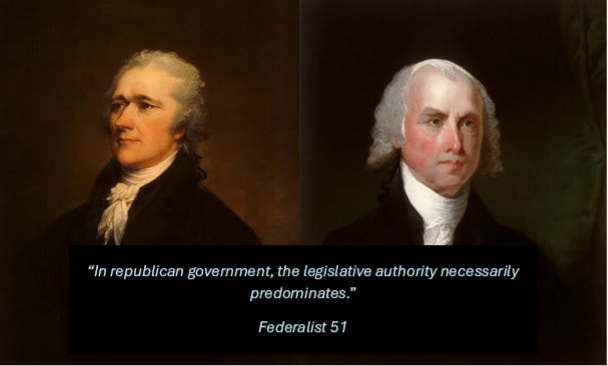
Recognizing that the Supreme Court cannot restore Congress’s power of the purse, even if it wanted to, since, as Hamilton noted, it is the weakest branch, makes clear that the real issue lies with Congress and its constitutional authority over federal spending. The difficulty of negotiating with President Trump combined with time constraints makes determining whether the government shutdown was the right move far from straightforward.
The desire to stand up to the norm-busting actions of the past 250-plus days is real for many Americans. I am not just referring to those who disagree with President Trump’s policies but also to those concerned with the way he has pursued his objectives. Process matters.
Yet the government shutdown is primarily a tool in brinksmanship-style negotiations. It is not designed to resolve the constitutional quagmire we now face. As far as I can tell, there was no real strategy to use the shutdown as a path to restoring the rule of law or Congress’s fiscal authority. Without such a plan, the shutdown becomes just another example of governing to win elections rather than winning elections to govern. And for that reason, it should have been avoided.
Author: Michelle M. Buehlmann, MPA, PhD, is a Clinical Assistant Professor in the Department of Political Science and Public Administration at the University of North Dakota. She received her graduate degrees from George Mason University. She served on Congressman George W. Gekas’s staff working on the Automatic Continuing Resolution legislation during the Clinton Administration. She also worked for Senator James M. Jeffords; the American Association of Colleges for Teacher Education; the California State University system; and the American Association of State Colleges and Universities. She is the author of “Let’s Shutdown the Government: An Instructional Game,” published on October 30, 2024, in the Journal of Political Science Education.

 (2 votes, average: 4.50 out of 5)
 Loading...
Follow Us!