Widgetized Section
Go to Admin » Appearance » Widgets » and move Gabfire Widget: Social into that MastheadOverlay zone

The Labyrinth and the Thread: Civic Life in the Age of Complexity
The views expressed are those of the author and do not necessarily reflect the views of ASPA as an organization.
By Mauricio Covarrubias
November 14, 2025
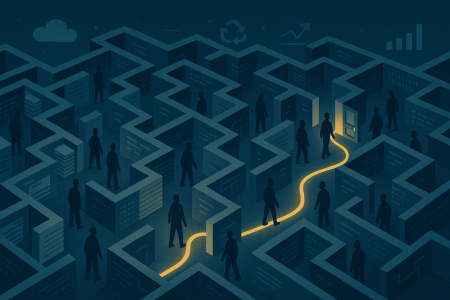
A defining feature of our time is not mere difficulty but overwhelming complexity, an ecosystem of dynamic, interdependent and uncertain relationships. For citizens, this is not an abstraction; it is the water we swim in, never sure if the current carries us toward safe harbor or over a waterfall. It turns the simple act of living into a daily act of navigation.
The Everyday Labyrinth
For the 21st-century citizen, this complexity manifests as a profound sense of disorientation:
As existential fatigue. The relentless demand to navigate byzantine bureaucratic and digital systems drains our vital energy. We are forced to become amateur experts in everything, a form of invisible “ghost work” that leaves us exhausted. This self-exploitation, echoing Byung-Chul Han’s “burnout society,” is the monumental effort required just to function within systems designed for control not care.
As paralysis. Life-altering decisions, such as buying a home or starting a family, feel impossible when the economic ground shifts with every announcement from a distant central bank. The future is no longer a predictable horizon but a foggy landscape of uncertainty. This is not a passing mood but a structural condition that breeds perpetual anxiety and analysis paralysis.
As a crisis of agency. Nowhere is this dissonance more painful than in the ecological sphere. We aspire to be guardians of the planet, yet individual action can feel like throwing a cup of water on a forest fire. We know we are part of the problem but feel powerless to become part of the solution, reduced to anguished spectators in a collective tragedy.
The Failed Response
Institutions built for stable, linear realities often respond to complexity by adding more walls: more regulations, more forms, more siloed departments. This failure stems less from bad faith than from a systemic blindness, the mistake of treating complexity as mere complication. Complicated problems yield to detailed manuals; complex problems demand adaptation, learning and humility. Applying a rigid one-dimensional policy to poverty or digital inequality is like trying to mend a net with a hammer: the tool is utterly wrong for the task.
Ariadne’s Thread: The Principles of Empathetic Governance
The solution is found in the ancient Greek myth of the Labyrinth. Theseus triumphed not by brute force but because Ariadne gave him a thread to navigate the maze and find his way back.
The fundamental duty of modern government is to provide this “Ariadne’s thread.” This transcends mere administration, entering the realm of practical philosophy and radical empathy.
a) To govern is to facilitate.
This requires a surgical rethinking of bureaucracy, not just digitizing unnecessary processes but eliminating them altogether. Every abolished procedure and every simplified form is a knot untied. It is an act of respect for the citizen’s time and a recognition that the state’s ultimate function is to enable a good life not to perpetuate its own machinery.
b) To govern is to clarify.
In the murky waters of misinformation, the government must become a beacon of clarity. This means communicating with radical transparency, admitting uncertainty when it exists and fighting the pollution of our information ecosystem with reliable, truthful signals.
c) To govern is to weave.
No single institution holds a monopoly on solutions. Effective governance is an exercise in collective intelligence, where the government acts as the central node in a network that connects universities, businesses and community organizations. Public policy should be a framework for social innovation not a rigid top-down dictate.
d) To govern is to build resilience.
Since we cannot predict every crisis, we must build societies capable of absorbing shocks and adapting. This means investing in critical thinking, robust public health, climate-resilient infrastructure and a social safety net that prevents anyone from falling into the abyss. It is the difference between a rigid ship that shatters in a storm and a flexible one that rides the waves.
The Measure of Governance
In the end, the true test of a government is how it helps people navigate life’s growing complexity, creating conditions for them to live with less anxiety and more agency. This demands a fundamental shift: to listen authentically, to understand real difficulties and to work diligently to alleviate them. Governing well today means making the labyrinth navigable for everyone, acknowledging that we are all simply trying to find our way.
Author: Mauricio Covarrubias is Professor at the National Institute of Public Administration in Mexico. He holds a Ph.D. from the National Autonomous University of Mexico (UNAM) and completed a postdoctoral fellowship in Government and Public Policy at the University of New Mexico in Albuquerque. He is co-founder of the International Academy of Political-Administrative Sciences (IAPAS). He can be reached at [email protected] and followed on X (formerly Twitter) @OMCovarrubias.
 (5 votes, average: 5.00 out of 5)
 Loading...
Follow Us!