Widgetized Section
Go to Admin » Appearance » Widgets » and move Gabfire Widget: Social into that MastheadOverlay zone
The Public Service Self Portrait: Formation, Values and Equity When It Matters
The views expressed are those of the author and do not necessarily reflect the views of ASPA as an organization.
By Malcolm K. Oliver
March 27, 2026
Not long ago, while standing in a museum gallery, I lingered in front of a quiet self-portrait by Helene Schjerfbeck. There was nothing theatrical in the image. No grand gesture. Just restraint, honesty and time written gently into the face. It reminded me of teaching public administration, where formation rarely happens loudly. It unfolds slowly, through repetition, presence and attention. In that moment, I realized how often we underestimate what is actually being shaped in our classrooms.
Most of us who teach public administration have experienced this realization. You may be standing in front of a classroom or sitting with a student during advising hours when you recognize that what is being formed is not only technical competence, but identity. Long after students forget software platforms or policy frameworks, they will remember how they learned to see public service, what mattered and what was treated as secondary. In that quiet recognition, the work begins to feel less like instruction and more like formation.
Public administration asks us to do more than manage programs or enforce rules. It asks us to give meaning to government authority in public life. H. George Frederickson reminded the field that public administration is anchored not only in efficiency and effectiveness but also in justice, democracy, human dignity and social equity. These values move from abstraction to reality when policy decisions reach households, neighborhoods, classrooms and public offices.
How we prepare future public servants shapes how they respond when values and institutional pressures collide. Recent debates over immigration enforcement and community response in Minnesota offer one such moment. Administrators there have been required to interpret enforcement directives while navigating public trust, civic dignity and human consequences at the same time. These situations rarely arrive neatly packaged. They unfold in meetings, emails and street-level decisions. They reveal quickly that technical competence alone is not enough.
Frederickson and David K. Hart described public service as a patriotism of benevolence, a commitment to exercise administrative authority with care for others rather than procedural precision alone. This framing shifts attention from what administrators are permitted to do to what they are responsible for protecting. It invites public servants to see themselves not simply as implementers of policy but as stewards of public trust.
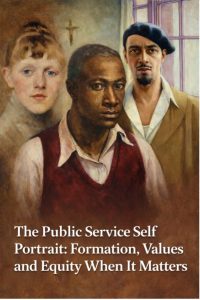
John Wilson’s self-portraits offer a visual echo of this responsibility. His subjects meet the viewer directly. There is no distance and no avoidance. The gaze conveys both dignity and expectation. It is the same posture public servants must carry into contested spaces, when communities are watching how authority is exercised and whether justice is taken seriously. In moments of strain, presence matters. How administrators show up, listen and act becomes part of the public record of trust.
Classical ethical thought reinforces this responsibility. Aristotle argued that law cannot be applied mechanically because every situation requires interpretation guided by justice rather than blind obedience. In modern administration, discretion is unavoidable. Whether implementing a social program or executing an enforcement directive, administrators make choices shaped by values as much as by rules. Frederickson expanded this insight by emphasizing that public servants must understand the spirit of law and policy, particularly when those policies produce unequal outcomes across communities. Without a commitment to equity, public administration can become efficient at producing harm rather than good.
Even the word public carries moral weight. Frederickson traced it to a shared sense of responsibility that moves individuals beyond narrow self-interest toward care for the common good. When self-interest becomes the dominant guide within public institutions, the moral character of public service weakens. Over time, professional habits and organizational routines can normalize this shift. What begins as convenience can gradually become culture.
This is why public service education must be formative. Ethics instruction does not eliminate hard choices. It equips future administrators to recognize complexity, weigh competing obligations and pause before conforming to pressure. It prepares students not only to navigate systems but to interpret responsibility when policy, politics and people collide.
For educators and practitioners in ASPA and NASPAA communities, this raises a simple but uncomfortable question. Are we preparing students only to function within organizations, or are we forming them to exercise judgment when values and institutional pressures collide?
Every classroom discussion, internship placement and mentoring conversation becomes a brushstroke. Students absorb what we emphasize and what we sideline. They notice whether equity is treated as central or optional, whether dignity is operationalized or rhetorical and whether courage is modeled or avoided. Over time, these lessons form a professional self-portrait.
Immigration enforcement debates make this dynamic especially visible. Administrators are asked to interpret policy directives, community safety concerns and human dignity obligations simultaneously. There is no neutral ground. The quality of these decisions depends on whether public servants have been prepared to recognize and weigh the moral dimensions embedded in administrative action.
Archibald Motley Jr. once painted himself not as a finished figure, but in the act of working. Palette in hand. Brush mid motion. The self-portrait remains incomplete because the work itself is still unfolding.
That image stays with me as I return to the classroom. The canvas is never blank for long. Each cohort adds new color. Each conversation leaves a trace.
The question is not whether a self-portrait will be painted. It already is. The question is whether the image we are helping shape reflects justice, dignity and responsibility, or quietly reproduces compliance without conscience.
In a time of moral strain, public service requires more than skill. It requires formation.
Author’s Note
This reflection draws on public administration scholarship by H. George Frederickson and David K. Hart on public values, social equity and ethical responsibility, as well as classical virtue ethics associated with Aristotle. Artistic references include Helene Schjerfbeck’s Self Portrait (circa 1884-85), John Wilson’s Self Portrait (1943), and Archibald Motley Jr.’s Myself at Work (1933), which informed the essay’s themes of formation, dignity and professional becoming.
Author: Malcolm K. Oliver, Ph.D., MPA, is dean of the John S. Watson School of Public Service at Thomas Edison State University and an active member of ASPA focused on ethics, equity and public leadership. He can be reached at [email protected].
 (7 votes, average: 5.00 out of 5)
 Loading...
Follow Us!