Widgetized Section
Go to Admin » Appearance » Widgets » and move Gabfire Widget: Social into that MastheadOverlay zone

The Quiet Power Of Women’s Leadership in Government
The views expressed are those of the author and do not necessarily reflect the views of ASPA as an organization.
By Denise Hendrix
July 21, 2025
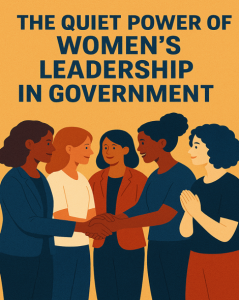
In my earliest memories, I watched my mother navigate the world with grace and determination. She bore burdens gracefully and stood tall like an oak tree. I learned from her that resilience works best in tough conditions. My grandmother, too, taught me to ask questions and never settle. These women were not public officials or professors but they were leaders in the truest sense. Their influence lives in me and in the way I view public service. As a public administrator and scholar, I see their legacy every day in women across government who lead not with fanfare but through networks of trust, resolve and community.
Women’s leadership is frequently restricted and neglected in professional and public service roles. Leadership in this field often focuses on hierarchy, policy outcomes and efficiency, with less emphasis on the interpersonal and relational aspects involved in workplace processes. It is time we change this.
The Quiet Power of Networks
My recent doctoral research explored collaborative governance between public and nonprofit organizations, focusing specifically on the role of middle managers. I found that women in these roles often leveraged informal communication, quick hallway chats, follow-up emails, volunteer task forces, not just to move a policy forward but to build trust across silos.
These networks are not visible to most people but they play an essential role for everyone. They foster shared purpose, accountability and initiative. Women, especially women of color, often manage these roles in bureaucracies with limited formal authority. These women are conveners and coalition-builders, turning fragmented resources into collective capacity.
In public service, where burnout is high and resources are limited, these networks are oxygen. They create space for innovation, inclusion and mutual support. But we rarely reward or even recognize this kind of labor.
The Double Burden: Leadership and Representation
Women in government are often asked to carry not only their job responsibilities but also the emotional labor of being the “only one” or the “first one.” They are expected to speak for communities, mentor young staffers and serve on diversity councils, all while meeting performance metrics and budget deadlines.
My research interviews revealed this burden clearly. One manager, a Black woman leading a child welfare unit, shared how she often served as an unofficial mediator between her mostly white executive team and her staff, most of whom were from the communities they served. She was a translator, a healer, a strategist and is exhausted.
This is not sustainable. Nor is it equitable.
Leadership models that ignore complexity may lose top public servants.
Rethinking What Leadership Looks Like
In the field of public administration, we have long debated what makes effective leadership. Classic models focus on decision-making, structure and control. But newer frameworks, like integrative collaborative governance and group theory, show us that leadership is also about relationships, trust-building and distributed influence.
Women’s leadership in government often lives in these frameworks. It shows up in how we convene community boards, manage conflict across agencies or mentor inexperienced staff in crisis. It often goes unnoticed in dashboards but has significant impact. And in today’s complex policy environment, where no agency or sector can solve problems alone, this kind of leadership is not just nice, it’s necessary.
A Call to Action
If we want a more effective, inclusive public sector, we must elevate and support the women who lead through networks. That means:
Formalizing mentorship: Build systems that connect emerging women leaders with seasoned professionals.
Recognizing relational leadership: Adjust performance evaluations to include collaboration and staff development.
Institutionalizing informal spaces: Create time and trust for peer learning, not just program reporting.
As we rethink leadership, let us widen our lens. Let us see the strength in those who hold coalitions together, who listen first, who build up others even as they carry their own load. These are the women who make public service not only work but work with heart.
Their networks are more than support systems, they are infrastructures of care, creativity and transformation. And if we choose to invest in them, the future of public leadership will be not only more equitable but more human.
Author: Dr. Denise Hendrix is a public administration professional with expertise in collaborative governance, homelessness policy, and nonprofit-public sector partnerships. With a background in both scholarship and practice, Hendrix focuses on improving system coordination and empowering middle managers in human services. Contact: [email protected]
 (3 votes, average: 5.00 out of 5)
 Loading...
Follow Us!


Artis Neal
August 19, 2025 at 9:53 pm
This article beautifully reflects my belief, deeply rooted in care, trust, and resilience.
Dr. Scena Webb
July 21, 2025 at 10:16 pm
This is a very insightful article and a powerful call to action.