Widgetized Section
Go to Admin » Appearance » Widgets » and move Gabfire Widget: Social into that MastheadOverlay zone
The Road Back: Can the PA Community Meet the Moment?
The views expressed are those of the author and do not necessarily reflect the views of ASPA as an organization.
By Michael R. Ford
October 24, 2025
Back when I taught undergraduate introduction to Public Administration (PA) I often used case studies to illustrate key PA concepts. One of the most powerful case studies was “How Kristin Died,” the brutal true story of how systemic bureaucratic failures contributed to the murder of a young woman. The case study is a powerful reminder of how bureaucratic systems grounded in rationality struggle to deal with irrational actors and irrational times.
I am thinking a lot about that lesson as I observe the ongoing struggle of U.S. institutions to function in fundamentally irrational times. As I write this, the federal government is shut down, troops are being deployed in American cities, free expression is under attack, and political violence is a continuing reality and threat. Further, actions such as the president’s social media post directing the Attorney General to go after political opponents, the HUD website’s message that “The Radical Left in Congress shut down the government,” and Homeland Security Director Kristi Noem’s airport video blaming one party for the government shutdown are evidence that the machinery of the federal government is being used for partisan purposes.
Some of these actions have raised concerns that the Hatch Act, which is aimed at ensuring the federal government is administered in a nonpartisan fashion, is being violated. But mostly I am finding these actions met with a degree of nihilism. I have heard some say that the federal government has long been weaponized against the party in power, at least now it is being done in the open. I have heard others say that a nonpartisan anything is a fiction. Still others are retreating into their partisan echo chambers, pointing fingers at one another.
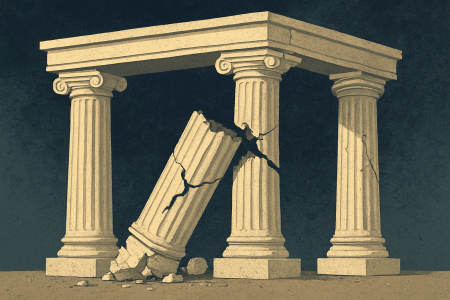
But the observations I or anyone else make do not change the fundamental reality that the core pillars of PA are eroding in real time. A government by definition cannot be effective if it cannot stay open. Perhaps more alarming, the acceptance and even celebration of the destruction of governing norms and institutions is rooted in widespread dissatisfaction with and distrust in government. Efficiency, another core pillar of PA, is inconsistent with moves toward a protectionist economy and the creeping return of a spoils system once associated with a bygone era. When government favors political goals first, it is by definition not as efficient as it could be. And then there is the issue of equity. The language of red states vs blue states, democratic cities and agencies, rural vs urban America all speaks to a government that allocates resources based on ideological criteria.
The ongoing political and social challenges in the U.S. pose an existential threat to American PA. We, and by that I mean academics and practitioners dedicated to our field’s core pillars, face some uncomfortable options. Do we pivot away from democratic values and focus on the technocratic, things like big data and AI? While important fields, I fear such a pivot could simply empower a more efficient retreat from core democratic principles. Do we embrace partisanship, accepting the argument that partisan attacks on democratic governance can only be countered with partisan defenses of democratic governance? I fear this approach alienates half the country as well as a great deal of our PA professionals and academics while destroying our field’s credibility in the process. Do we sit by and wait, doing the best we can, hoping for things to settle down? But what if things do not calm down?
I personally favor a two-track strategy where we 1) double down on showing how democratic governance and the core pillars of PA can and do matter at the local level and 2) reinvigorate civics education into PA and beyond so that the next generation has the core knowledge and tools to function in a pluralistic society. That means embracing the study of free speech and expression, founding documents, and classic liberalism. The long-term goal is to have proof of concept that rational governing systems built on nonpartisan administration produce better results, and to have leaders committed to pluralism working in those rational systems.
I am genuinely curious what others in PA, including our professional organizations, are thinking regarding a coherent strategy at this moment. The PA community is diverse and fragmented, but if there was ever a time for people across ideological and intellectual divides to unite in defense of the basic foundation of PA, it is now. I take comfort in the fact that our democratic institutions have proven resilient and that the U.S. Constitution has guided us through difficult times in the past. But I go back to the aforementioned case study and wonder, how does the Constitution protect us if a critical mass of leaders choose to ignore it?
Author: Michael R. Ford is the Director of the Wisconsin Institute for Citizenship and Civil Dialogue at the Universities of Wisconsin. He frequently publishes on the topics of public and nonprofit board governance, accountability and education policy. He is an elected member of the Oshkosh Area School District Board.
 (3 votes, average: 5.00 out of 5)
 Loading...
Follow Us!


Charles Mason
October 25, 2025 at 6:54 am
Interesting read, but it feels less like public administration and more like political commentary. If the PA Times truly stands for nonpartisan analysis, shouldn’t it examine failures on both sides of the aisle? The piece singles out conservative actors while ignoring years of agency politicization under progressive leadership. Public administration should be about management, accountability, and fairness—not ideology. Let’s remember that bureaucracy exists to serve the people, not to control them.
Michael Abels
October 24, 2025 at 3:35 pm
I am afraid our Constitution is not holding. Indications are the collapse of Congress to check the President, active discussion of a third Trump turn, political gerrymandering to destroy concept of one person one vote, voting restrictions e.g. reducing polling locations and eliminating mail in voting, government shutdown with no active political action to find middle ground.
PA must lead in asking the question, is the public and political alienation so great that we must create the platform for forming a new system of government, one that protects human freedom and creates a system of governance to unite the country around common aspirations?
Guero Nunez
October 24, 2025 at 2:55 pm
When a significant portion of a society is permissive of behavior as your article mentions, then the results is predictable. We are facing / enduring accepted criminality. The public service models that we were taught that strive for civil society to flourish are not accepted now. It is so disappointing, no, it is malevolent. There may be a few sylos of uncorrupted servants, but we have seen that these very few are now hunted and purged. I would love to say that I have an answer to help resolve the problem(s), but I do not. Keep working and do not comprise your ethical values when serving the public. I suppose there will be a tipping point, I just hope there will be something left. Good article thank you.