Widgetized Section
Go to Admin » Appearance » Widgets » and move Gabfire Widget: Social into that MastheadOverlay zone
Trust That Delivers: A Model for Public Collaboration
The views expressed are those of the author and do not necessarily reflect the views of ASPA as an organization.
By Denise Hendrix
October 20, 2025
Introduction
In today’s complex and often fragmented public and nonprofit landscape, collaboration is no longer optional, it is essential. From tackling housing insecurity to advancing health equity and streamlining human services, success increasingly depends on the ability of cross-sector leaders to work together in sustained and meaningful ways. Yet too many collaborative efforts stall or fail not because of lack of funding or policy authority, but due to a deeper, more elusive issue: trust.
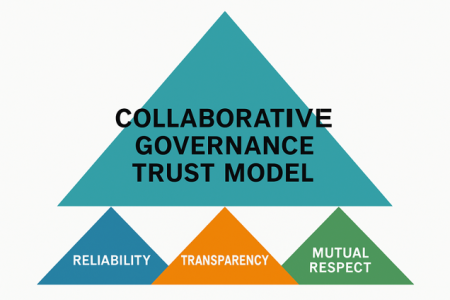
Although trust and governance are well discussed in collaborative literature, they are rarely broken down into practical, repeatable frameworks that public leaders can use to guide daily decision-making. That’s why I have developed the Collaborative Governance Trust Model (CGTM), an empirically grounded framework for building and sustaining trust in public and nonprofit partnerships. Based on my doctoral research and years of leadership in the field, CGTM identifies three essential pillars that anchor high-performing collaboration: Reliability, Transparency and Mutual Respect.
While “trust” and “collaborative governance” are established constructs in the literature, the Collaborative Governance Trust Model (CGTM) is the author’s empirically derived and branded framework for structuring trust in public/nonprofit collaborative settings. This model responds to a gap in the scholarship noted by many, including Ansell & Gash (2008) and Emerson & Nabatchi (2012), who argue that collaborative governance depends on shared understanding and commitment. My contribution builds on these insights and offers a practical trust structure rooted in interviews with senior leaders across government and nonprofit sectors.
Pillar 1: Reliability
Reliability is the foundation of any successful partnership. It means doing what you say you will do consistently, predictably and with follow-through. In the context of collaborative governance, reliability shows up in meeting timelines, honoring memorandums of understanding (MOUs) and delivering programmatic results. Without it, even the most well-intended partnerships erode.
Consider a multi-agency housing task force. When one partner consistently misses deadlines for resource deployment or data sharing, trust suffers not just with that entity but across the system. On the other hand, when each organization reliably contributes its part, the coalition strengthens and can focus on the work at hand: creating stable housing pathways for vulnerable residents.
Pillar 2: Transparency
Transparency is not just about open data or public dashboards, it’s about communicating clearly, early and often. Transparency fosters trust by reducing ambiguity and allowing all parties to make informed decisions. This is especially critical when navigating sensitive issues such as funding shifts, staffing changes or service delivery gaps.
In public health equity efforts, transparency can mean the difference between success and stagnation. For instance, when government agencies share vaccine distribution data with nonprofit partners serving marginalized communities, those nonprofits can target outreach more effectively. The inverse is also true: when data is withheld, rumors flourish and community trust deteriorates.
Pillar 3: Mutual Respect
Mutual respect elevates every seat at the table. It affirms that all partners, regardless of sector, size or status, bring valuable expertise and perspective. This pillar requires equity in voice, respect for cultural differences and attentiveness to power dynamics that may marginalize certain participants.
In human services coordination, mutual respect is often the glue that holds disparate organizations together. For example, a city social services department working alongside grassroots nonprofits must intentionally center community knowledge, not just professional credentials, to co-create effective solutions. Without respect, collaboration becomes tokenism. With it, policy design becomes more inclusive, responsive and legitimate.
Trust and Communication: A Symbiotic Relationship
These three pillars—Reliability, Transparency and Mutual Respect—are deeply interconnected and all are reinforced through communication. Communication is not a fourth pillar; it is the lifeblood that animates and sustains them all. When communication is poor, even reliable and respectful partners may be misperceived. When communication is strong, misunderstandings are minimized and conflict becomes manageable.
Too often, organizations invest in legal agreements, governance charts or even branding strategies but neglect the daily communication practices that build or break trust. If public and nonprofit leaders want to move the needle on big issues, they must make trust-centered communication a strategic priority.
Why CGTM Matters Now
The Collaborative Governance Trust Model offers a usable, research-based framework for leaders seeking to strengthen partnerships and accelerate policy outcomes. In domains like housing insecurity, health equity and human services where no single entity can solve the problem alone, trust is not a soft value. It is infrastructure.
Public administrators, nonprofit executives and scholars alike must treat trust as a strategic tool of governance, not an accidental byproduct. Whether convening coalitions, managing grants or navigating crisis response, CGTM provides a roadmap for building the kind of trust that drives results.
What’s Next
This article introduces the CGTM as a foundational concept. In future work, I will explore how organizations can assess these pillars over time, how trust indicators correlate with measurable policy outcomes and how the model can be adapted for different institutional settings. Ultimately, the CGTM is designed not just as a framework but as a tool for transformative collaboration in public service.
Author: Dr. Denise Hendrix is a public administration professional with expertise in collaborative governance, homelessness policy and nonprofit public sector partnerships. With a background in both scholarship and practice, Hendrix focuses on improving system coordination and empowering middle managers in human services. Contact: [email protected]

 (2 votes, average: 4.50 out of 5)
 Loading...
Follow Us!


먹튀검증
October 23, 2025 at 2:23 am
Adult relationships may mirror early dynamics—seeking approval, fearing abandonment, or tolerating emotional neglect
Stephen King
October 20, 2025 at 4:46 pm
Very interesting piece.