Widgetized Section
Go to Admin » Appearance » Widgets » and move Gabfire Widget: Social into that MastheadOverlay zone

Understanding the Current Crisis in Public Administration: Part 3 – The Arc of Empire
The views expressed are those of the author and do not necessarily reflect the views of ASPA as an organization.
By Erik Devereux
July 25, 2025
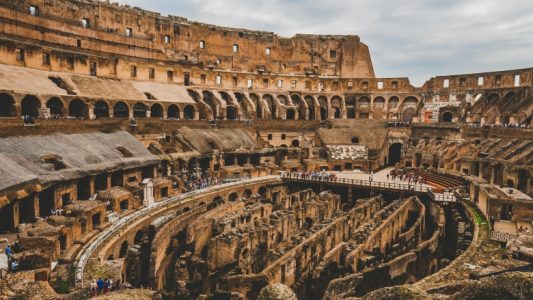
This is the third column in a series on the current crisis in American public administration that is rewriting much of what we think about American government (first column, second column). The series invokes plate tectonics as a metaphor for thinking about what has transpired with the federal government since January 20. What matters most are the subterranean forces slowly building up immense pressures which ultimately are expressed in seemingly rapid shifts in the public landscape. One of those forces may be the inevitable arc of empire.
Before delving more into the idea, first let us consider if the USA should be thought of as an empire. While I know many who object to that characterization, this may be an instance of, “If it looks like duck, walks like a duck, and sounds like a duck…” Please note that in their prime, the denizens of most prior empires (the British being a canonical example) did not use the language of empire. Instead, those at the center of an empire speak in glowing of terms about how their benign leadership is responsible for peace, stability and unprecedented prosperity among those they lovingly govern.
Here are some facts about the USA that speak to the relevance of empire:
- The USA maintains the same level of military capability as all other countries on Earth combined.
- No other country on Earth can deploy one complete aircraft carrier taskforce when the USA generally can deploy more than six such taskforces simultaneously.
- Almost none of the military capability of the USA is focused specifically on defending the homeland from attack but mostly is about projecting force far away. As an extreme example, those “bunker buster” bombs dropped on Iran recently were delivered by bombers launched from a base in Missouri.
- Since its founding, the USA has waged at least one minor military conflict every three to five years and one major military conflict every 10 years without fail. As with all other empires, the American one constantly is at war and publicly glorifies military service.
- The U.S. dollar unambiguously is the world’s primary currency and, if there is a true world leader, that would be the chair of the Federal Reserve. In their day, the Romans and the British held exactly the same position.
Most remarkably, the USA is the first country in world history to claim to have a national interest in every other place on the planet. The Russians and the Chinese, in contrast, focus their attention on specific regions and ignore others. No country in human history other than the USA has possessed both the resources and the commitment to be entangled in the affairs of every other country. Or, at least, that was the case until the first Trump Administration.
I have talked about this with people outside the USA and many of them see an empire experiencing rapid decline. The Trump Administration is not a cause of this decline but a familiar symptom to those who study world history in depth. Since most Americans do not study history at all, this is why those who view President Trump as a symbol of renewed American strength are completely in error.
While the science of empire is still being perfected, the hard empirical truth is that every empire eventually has decayed and collapsed. The American empire mostly is associated with the period 1945 to the present in the aftermath of World War Two and the development of nuclear weapons. At most, that is not even a century. Other famous empires have lasted between four and 40 times as long. In the great scheme of things, the American empire may not rate in the top 20 when historians eventually conduct a final autopsy.
Why do empires decline and fall? I recently reviewed some of the classics among books devoted to this question written by Mancur Olson, Douglas North, and others of that intellectual caliber. A common theme among all of them is that empire rots from within rather than being defeated from the outside. The primary source of the rot is the propensity of society to divide into competing interest groups that put their well-being ahead of the country. In other words, James Madison was correct by warning us in Federalist #10 about the threat posed by “faction.” Madison hoped that the system of government created by the Constitution would control factions. Best I can discern, the system Madison envisioned is not working as intended.
I will discuss this in more detail in the next column in the series. Some of the story is about the connection between the arc of empire and aging infrastructure. Much of this will be speculative. But I can say without any doubt that the leaders of empires at their peak do not pose topless on horseback for the paparazzi or proclaim boldly in circus-like atmospheres on TV how powerful they are or make sport out of destroying the careers of dedicated public servants. The leaders of thriving empires understood what Teddy Roosevelt meant by, “walk softly and carry a big stick.”
Author: Erik Devereux is Teaching Associate Professor in the Department of Public Policy, Management, and Analytics at the University of Illinois-Chicago. He has a B.S. from the Massachusetts Institute of Technology (Political Science, 1985) and a Ph.D. from the University of Texas at Austin (Government, 1993). He is the author of Methods of Policy Analysis: Creating, Deploying, and Assessing Theories of Change (available for free here). Email: [email protected]. More content is available here.
 (3 votes, average: 5.00 out of 5)
 Loading...
Follow Us!