Widgetized Section
Go to Admin » Appearance » Widgets » and move Gabfire Widget: Social into that MastheadOverlay zone
What Do We Celebrate? Selective Remembrance and the Administration of History
The views expressed are those of the author and do not necessarily reflect the views of ASPA as an organization.
By George S. Welch
July 17, 2026
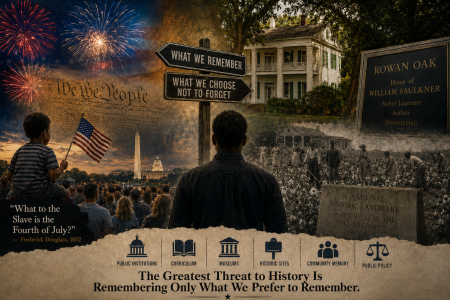
Every July, Americans gather to celebrate Independence Day. Fireworks illuminate the night sky, flags wave from front porches and political leaders invoke the nation’s founding ideals of liberty, equality and self-government. For many Americans, the Fourth of July represents a celebration of freedom.
For others, the holiday raises a more difficult question: freedom for whom?
The question is as old as the nation itself. In 1852, Frederick Douglass challenged Americans to confront the contradiction between the principles celebrated on Independence Day and the realities experienced by millions of enslaved people. More than 170 years later, the question continues to resonate because it points to a broader challenge in American public life: the difference between remembering history and remembering it honestly.
Public administration scholars spend considerable time examining budgets, personnel systems, policy implementation and organizational performance. Less attention is given to another governmental responsibility that shapes civic life: the administration of collective memory.
History is not simply preserved. It is selected, funded, interpreted, curated and presented through public institutions. Historic preservation boards determine which sites receive recognition. Museum governing authorities establish interpretive frameworks. Marker commissions approve historical narratives. Curriculum committees influence what students learn. Legislative appropriations determine which stories receive institutional support. These decisions help shape how communities understand their past and ultimately themselves.
Recently, I visited two historic Mississippi sites.
The first was Melrose, a plantation preserved as a national historic landmark. The second was Rowan Oak, the home of Nobel Prize-winning author William Faulkner. Both sites are historically significant. Both deserve preservation. Yet both illustrate a challenge that extends far beyond Mississippi.
Visitors encounter architecture, artifacts, family histories and cultural achievements. They learn about literary accomplishment, regional heritage and historical significance. Yet beneath those narratives are broader stories involving labor, race, power, exclusion and inequality. The challenge is not whether these places should be preserved. The challenge is whether preservation is accompanied by sufficient context to understand the full story.
This tension is not limited to historic sites.
Across the country, debates continue over monuments, curriculum standards, museum exhibits, public commemorations and historical markers. These debates often revolve around the same underlying issue: who is included in the story, who is represented within the system and who possesses the authority to define both.
Too often, public discussions become trapped between accusations of erasing history and accusations of glorifying it. In reality, the more persistent challenge is selective remembrance.
Selective remembrance occurs when societies preserve the portions of history they find affirming while minimizing, compartmentalizing or distancing themselves from the portions they find uncomfortable. It allows communities to celebrate achievements while avoiding contradictions. It permits acknowledgment without full engagement.
The pattern appears throughout American history.
Americans celebrate Independence Day while often giving less attention to the fact that many of the nation’s founding promises remained inaccessible to large segments of the population. Juneteenth commemorates emancipation, yet conversations about Black Codes, disenfranchisement, racial violence and segregation frequently occupy a smaller place in public discourse. Historic sites preserve physical structures while sometimes struggling to communicate the full realities of the systems that sustained them.
The issue is not whether these events should be commemorated. They should.
It is whether commemoration becomes a substitute for understanding.
For public administrators, this is more than a cultural debate. Public institutions influence how citizens understand their communities through decisions involving funding, preservation, interpretation, education and representation. Those decisions affect civic identity, public trust and democratic participation.
The purpose of public history is not to make citizens comfortable. Nor is it to make them ashamed. Its purpose is to make them informed.
A plantation can be historically significant and inseparable from slavery. A literary landmark can be culturally important and connected to larger systems of inequality. A national holiday can be both a celebration of freedom and a reminder of freedoms historically denied. Public institutions must recognize that historical complexity often exists alongside public responsibility.
Public institutions best serve the public not by choosing among these truths but by presenting them together.
As Americans celebrate another Independence Day, public administrators should remember that governance involves more than managing programs and implementing policies. It also involves stewardship of the public record and the public narrative.
The question is not whether history should be preserved.
The question is whether it will be preserved honestly.
Because the greatest threat to historical understanding is not forgetting.
It is remembering only the parts we prefer to remember.
Author: George S. Welch is a public administration scholar, historian, and public servant whose work examines how history, policy, and governance intersect to shape public institutions and civic life. Contact: [email protected]
 (1 votes, average: 5.00 out of 5)
 Loading...
Follow Us!