Widgetized Section
Go to Admin » Appearance » Widgets » and move Gabfire Widget: Social into that MastheadOverlay zone
When Guardrails Feel Weak: What Public Servants Can Do When Institutions Stall
The views expressed are those of the author and do not necessarily reflect the views of ASPA as an organization.
By George S. Welch
April 17, 2026
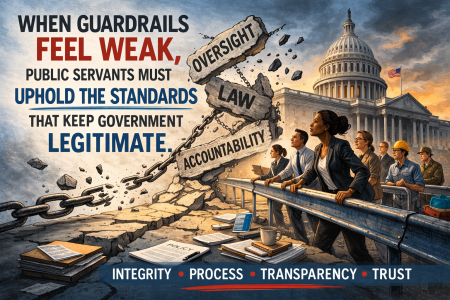
Public administration runs on a simple premise: power is exercised within limits. Laws, oversight and professional norms are not red tape. They are the guardrails that keep government legitimate.
Many public servants and citizens feel those guardrails weakening. They see fast executive action, delayed legislative response and court decisions that arrive late, unclear or both. Whether someone supports or opposes a particular policy is not the central issue. The deeper concern is what happens to governance when restraint looks optional.
This matters to public managers because legitimacy is not abstract. Trust shapes compliance, cooperation and the daily ability of agencies to do their work. When the public believes government is acting without meaningful checks, frontline staff pay the price first.
The Administrative Cost of Institutional Passivity
When institutions appear slow or inconsistent, agencies do not operate in a neutral environment. They operate in a climate of suspicion. That produces predictable management problems.
Public servants are asked to implement high-conflict decisions while absorbing reputational blowback for choices they did not make. Mission clarity suffers. Turnover risk rises. As political conflict intensifies, routine decisions become flashpoints, especially in enforcement, benefits administration, procurement, public health and emergency management.
Over time the public stops separating career professionals from political leadership. Citizens see “government” as one unit and judge it as one unit. That perception may be unfair to the professionals doing the work, but it is real and it changes how the public responds to policy implementation.
What “Unchecked” Looks Like at Street Level
Public servants do not experience constitutional imbalance as theory. They experience it as operational strain.
It shows up when:
- policy direction changes faster than training and internal controls can adapt
- guidance is vague, then enforced aggressively
- oversight arrives after the most consequential steps have already been taken
- court decisions allow major actions to proceed without clear public explanation
None of these points requires agreement on any single controversy. They describe a management reality: speed without clarity increases error, inconsistency and public distrust.
Guardrails are not only constitutional. They are managerial.
Public administration has its own set of guardrails. Even in high-pressure moments, agencies can protect legitimacy by strengthening the basics. The goal is not to slow necessary action. The goal is to ensure that action remains lawful, consistent and explainable.
Practical Steps for Public Managers
Public managers can focus on five practical moves:
- Tighten documentation where discretion is highest. Discretion is unavoidable. What matters is whether it is traceable and defensible. Require short decision memos for high-impact calls. Preserve the “why” alongside the “what.”
- Reinforce supervisory review for high-consequence actions. Add a second set of eyes for decisions that carry serious liberty, safety or livelihood impacts. Review is not distrust. It is risk management.
- Standardize public-facing guidance when rules change. If the public cannot understand what is expected, compliance collapses. Publish plain-language updates quickly. Keep them current and easy to find.
- Expand training on due process and equal treatment. Most operational failures in turbulent times are not about bad intent. They are about uneven interpretation and rushed implementation. Training restores consistency.
- Track outcomes to detect disparities early. When conflict rises, so does the risk of uneven implementation. Use dashboards and routine audits to spot divergence across offices, regions or teams.
These steps do not substitute for Congress or the courts. But they reduce the damage that confusion and conflict create inside agencies.
Leadership, Ethics and Public Trust
Periods of institutional strain test the public service. The temptation is to withdraw into minimal compliance. The better path is to lead with integrity and process.
That means insisting on clarity before execution when possible. It means documenting decisions for accountability. It means treating affected communities with respect, even when the politics are heated. It also means protecting internal channels that surface risk, compliance concerns and operational hazards before they become crises.
It also means communicating up the chain. Public managers should be candid about implementation capacity, training timelines, staffing realities and legal risk. Quietly “making it work” can feel responsible in the moment, but it can also normalize unrealistic directives and weaken the very guardrails that protect agencies and the public.
The Lesson for Public Administration
Democratic governance weakens when extraordinary actions become routine and routine accountability becomes optional. That is not a partisan claim. It is a warning from public administration itself.
Public servants cannot fix constitutional balance alone. But they can protect legitimacy where they stand: in procedures, transparency, consistency and ethical implementation. In times of distrust, those everyday disciplines become the difference between a functioning system and a cynical one.
Public administration is often described as the work of making democracy real. In moments when institutions appear stalled, that work becomes even more important, not less.
Author: George S. Welch is a public administration scholar and public servant focused on governance, accountability and institutional capacity.

 (5 votes, average: 4.60 out of 5)
 Loading...
Follow Us!