Widgetized Section
Go to Admin » Appearance » Widgets » and move Gabfire Widget: Social into that MastheadOverlay zone

Understanding the Current Crisis in Public Administration: Part 5 – Demographics Are Destiny
The views expressed are those of the author and do not necessarily reflect the views of ASPA as an organization.
By Erik Devereux
September 26, 2025
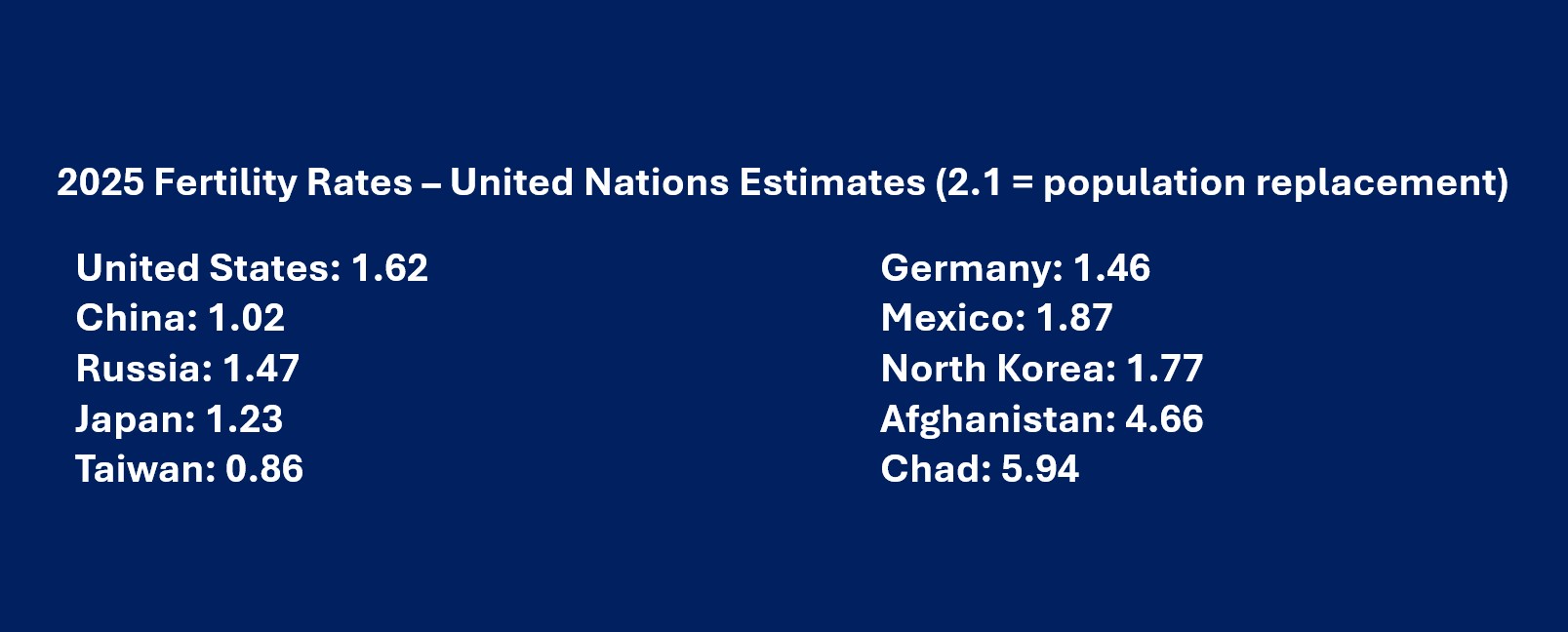
This is the fifth column in a series on the current crisis in American public administration that is rewriting much of what we think about American government (first column, second column, third column, fourth column). The series invokes plate tectonics as a metaphor for thinking about what has transpired with the federal government since January 20. What matters most are the subterranean forces slowly building up immense pressures which ultimately are expressed in seemingly rapid shifts in the public landscape. Perhaps the most inexorable of those forces are long-term demographic trends which fundamentally are beyond political influence yet eventually can topple empires.
According to the latest demographic statistics, about half of the countries on Earth now have a fertility rate (live births per mother) of less than the 2.1 necessary to replace the current population. Many demographers predict that by the end of this century the only countries with a rate above 2.1 will be a handful in Africa. The graphic accompanying this column displays the current rates for a few select countries of current interest and one–Chad–which is the current #1 for fertility. Please pay special attention to the rate for China, the country that otherwise seems primed to succeed the U.S. as the world’s top empire.
The story of China is very instructive. Most reading this column are aware that decades ago the Chinese Communist Party approved a “One Child” policy in attempt to control population growth. Each couple was limited to having one offspring and the policy was enforced rather harshly. Because of the high value placed on male children in Chinese culture there were unintended consequences mostly in the form of female infanticide and a high rate of female infants abandoned for adoption. You may know as I do several couples in the U.S. who adopted these abandoned girls and raised them as Americans. But when the Chinese leadership realized the damage done to the long-term demographics, they attempted to reverse course and encourage fertility. That has not worked, for economic reasons, as Chinese couples persist in preferring to have just one child.
The lesson here for autocrats is clear: You certainly can deploy the power of the State to prevent fertility but there is little you can do to force people to have children. If for whatever reason your society goes down the road toward a fertility rate below replacement, good luck turning that around in time.
Now look at the graphic again and think about Russia, Japan, China and North Korea, societies that predominately are closed off to immigration and marriage with foreigners. Just like the U.S. and all other countries with a fertility rate below 2.1, the future is bleak at best. Until the current U.S. administration, our primary strategy was to encourage immigration to keep our population slowly growing. As I have pointed out in other columns in the PA Times, no one seems to have a vision of economic growth without population growth. This is a crucial existential issue for every country on Earth. The U.S. was in the mode of solving its demographic problem by siphoning populations away from other countries.
Much attention has been devoted to the political turmoil caused by White Americans realizing that shifting demographics would push them into a minority status by 2050. One of my former neighbors in Maryland has been criticized for publishing a book years ago that predicted the long-term dominance of the Democratic Party as a consequence. (The criticism suggests this book galvanized the MAGA movement that elected Donald Trump.) Such turmoil is likely to pale in comparison to what will happen when the total population of the U.S. goes into decline.
The Trump Administration actively has been discussing population decline and encouraging at least White Americans to have more children (not so much for any other demographic groups at least for now). Just like with China, personal realities will dominate over state rhetoric and most American couples politely will decline to procreate. For some this will be about politics, for others about economics, and for quite a few about concerns for the future direction of the country. As leaders of all stripes have learned before, if you think voting with your feet sends a message wait until you experience voting with the uterus. Quite literally, current demographic trends will put most of the world’s leading economic and military powers entirely out of business within a century or so. China already is on the verge of being the largest assisted living on the planet.
How could this change? History says demographic change would require taking steps to increase democracy, freedom and civil liberties, reduce economic inequality and stress, stop and then reverse climate change, and completely shut down military conflicts worldwide. Why? Because these measures would instill hope for a better tomorrow. And that hope is the greatest and only true aphrodisiac ever found.
Author: Erik Devereux is Teaching Associate Professor in the Department of Public Policy, Management and Analytics at the University of Illinois-Chicago. He has a B.S. from the Massachusetts Institute of Technology (Political Science, 1985) and a Ph.D. from the University of Texas at Austin (Government, 1993). He is the author of Methods of Policy Analysis: Creating, Deploying, and Assessing Theories of Change (available for free here). Email: [email protected]. More content is available here.
 (1 votes, average: 5.00 out of 5)
 Loading...
Follow Us!


Jonathan Justice
September 29, 2025 at 11:32 am
I’m not an economist, so others might correct me, but I think that the key metrics for material standard of living are per capita (GDP or other measure of the total economy) and its distribution, rather than simply the total amount. If population shrinks faster than the total economy and distribution is managed in a way that doesn’t lead to unreasonable inequality, what’s the problem with declining population? And then of course there’s the distinction between material standard of living and experienced well-being, and the associated question of how much is enough. . . .
James Savage
September 26, 2025 at 4:38 pm
What explicitly are the negative consequences of a national population with a lower birthrate? Were the countries mentioned here, the U.S., China, etc., really worse off politically, economically, environmentally, and socially with smaller populations? Is a country with a fertility rate of 3 or 4 really better off than one with a rate of 2.0? Will countries really be “entirely out of business” as this article suggests?