Widgetized Section
Go to Admin » Appearance » Widgets » and move Gabfire Widget: Social into that MastheadOverlay zone
Understanding the Current Crisis in Public Administration: Part 7 – We Have Met the Enemy and It Is Us
The views expressed are those of the author and do not necessarily reflect the views of ASPA as an organization.
By Erik Devereux
November 14, 2025
This is the seventh column in a series on the current crisis in American public administration that is rewriting much of what we think about American government (first column, second column, third column, fourth column, fifth column, sixth column).
The series invokes plate tectonics as a metaphor for thinking about what has transpired with the federal government since January 20. What matters most are the subterranean forces slowly building up immense pressures which ultimately are expressed in seemingly rapid shifts in the public landscape. Among these pressures are unavoidable conflicts over political power between the political and the administrative sides of government in the United States.
Teaching the MPA core course “Foundations of Public Service” this semester has reminded me how many of the leading thinkers in American public administration previously posted warnings that this current moment, in which a presidential administration is engaging in open warfare against its own government, is inevitable. Despite the frequent appeals to “nonpartisanship” and the value of merit in the Civil Service, public administration is well aware that the putative firewall between the federal bureaucracy and politics is an illusion.
Here are some of those warnings.
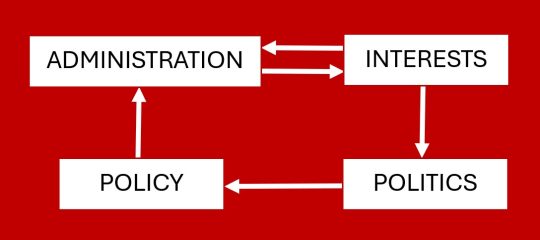
- In 1949 (!) Norton Long admonished the field that “The lifeblood of administration is power.” Furthermore, as partially captured by the diagram at the top of this column, such power is accumulated by administrators through their relationships with external interests often in direct competition with the power of political leaders appointed or elected above them.
- In 1990, R.J. Stillman wrote insightfully about the deep structural defects of a U.S. Constitution that completely bypassed the place of administration within the government created in 1787 as an intentional omission negotiated by American elites still smarting from their recent experiences under the British Crown.
- In 1991, Ted Lowi warned us that the federal government as transmuted by the New Deal and the resulting American welfare state did not rest on solid constitutional principles and was likely to prove vulnerable to exactly the strategies and tactics we see in 2025 to dismantle that version of the state.
- In 1992, Marissa Martino Golden published an analysis of the Reagan Administration’s administrative presidency strategy (the label coined by Dick Nathan) for what essentially was the exact same approach being used today by the Trump Administration to dismantle decades of bureaucratic evolution.
- In 2014, Don Moynihan and Joe Soss published their statement of policy feedback theory with the central finding that “Policy implementation can reorganize power relations in a society, redefine terms of political conflict, mobilize or pacify constituencies, and convey cues about group deservingness… As policies are put into practice, they can produce new social identities and political interests or establish new configurations of rights and obligations.”
When I put this together in the current context, here is what this all means. For the political opponents of the American version of the welfare state, the bureaucracy that administers those policies is in and of itself a power center which will seek to block change. As political stress over the expansion of the welfare state increased from 1981 forward, the likelihood of an eventual earthquake like that of January 20, 2025 became inevitable.
There is no path forward for public administration today along the apolitical route surveyed by Woodrow Wilson in 1887. We need to accept that in the eyes of the framers of the Project 2025 agenda, everything that we in this field think of as our proper and legitimate domain within the American constitutional system makes us the enemy whether we acknowledge that status or not. Remember that there is no article in the U.S. Constitution that even vaguely references a public bureaucracy’s existence.
As I have written previously in the PA Times, the concerted internal attack on the federal government has developed because that government demonstrated an extensive capacity to serve the broader public interest. The ending of Jim Crow segregation is one example of that power. When Ronald Reagan boldly stated that government is the problem, what he really conveyed to many of his supporters was that government is a problem when you are seeking the private interest over the values of the public interest.
History teaches a very profound lesson that seems lost on the Trump Administration. When interfering in a complex system with many interconnections and feedbacks, generally taking an incremental approach always is the best choice. Bold, rapid shifts may have short term results but in the longer term the metaphor of the swinging pendulum applies. Push that pendulum way to one side and it inevitably will swing back equally in the other direction. I expect that those who pushed for Project 2025 someday will rue that approach as having opened the way for a vast strengthening of the state they sought to diminish. We in public administration need to prepare for our moment when we can help make the federal government once again a force for serving the public interest.
Erik Devereux is Teaching Associate Professor in the Department of Public Policy, Management and Analytics at the University of Illinois-Chicago. He has a B.S. from the Massachusetts Institute of Technology (Political Science, 1985) and a Ph.D. from the University of Texas at Austin (Government, 1993). He is the author of Methods of Policy Analysis: Creating, Deploying, and Assessing Theories of Change (available for free here). Email: [email protected]. More content is available here.
 (No Ratings Yet)
 Loading...
Follow Us!


Brint Milward
November 14, 2025 at 3:16 pm
Erik, this is an excellent analysis of the attack on the public bureaucracy by the Trump Administration. Long, Lowi, Golden, Stillman, Moynihan, and Soss all predicted the present moment. The Wilsonian Paradigm is shattered with its emphasis on expertise and impartially. Is there a normative case a bureaucracy that is founded on a stronger foundation than just doing to them what they did to us?